Ecclesia Iesu Christi · una, sancta, catholica et apostolica
The Church of Jesus Christ: One, Holy, Catholic and Apostolic
The line of true religion does not begin in the first century as though God had previously abandoned mankind. It runs from the first parents through Abel, Seth, Noah, Melchizedek, Abraham, Israel, the prophets and the Temple toward Jesus Christ.
Christ fulfils this history and gives it a visible, sacramental and apostolic form in His Church. The question is whether that same society can still be identified by doctrine, worship, succession, universal mission and communion with the successor of Peter.
Christ founds one visible society with doctrine, sacraments, apostolic succession and a principle of universal communion.
START HERE · FOR THE SEARCHER
Where does the Church founded by Jesus Christ remain visibly present?
First learn how this religion or Christian community understands itself. Then test its central claims by reason, public history and its own sources. Finally ask whether it reaches the full truth revealed in Jesus Christ and preserved by the apostolic Church.
1 · UNDERSTAND
What does this tradition claim?
After asking whether God exists and whether Christ is credible, the search becomes concrete: did Jesus found a visible society, give it authority, sacraments and a mission, and promise that it would endure?
2 · WHY IT MATTERS
Why does this matter for eternity?
If Christ founded a visible Church and entrusted it with doctrine, sacraments and authority, identifying that Church is a duty of conscience. The question determines where the believer receives the full means of communion with Christ.
3 · WHERE THE EVIDENCE LEADS
What conclusion does the evidence support?
The Catholic case identifies one continuous subject through apostolic succession, Eucharistic worship, universal communion, doctrinal development and the Petrine office. Human sin requires reform within that Church; it does not require a later invisible substitute or total restoration.
READ IN THIS ORDER
Learn what the tradition teachesBegin with its origin, authorities, view of God, view of the person, worship and promised salvation.
Test its central claimsExamine coherence, chronology, primary sources and the strongest form of its own case.
Compare the final answerAsk whether it truly reconciles the person to the Creator and corresponds to Christ’s public revelation.
OPTIONALSource notes and argument map · The Church of Jesus Christ: One, Holy, Catholic and Apostolic
This optional layer verifies the conclusion instead of merely repeating it. It identifies the controlling terms, dates the decisive witnesses, links the primary texts and states which premise the strongest contrary case must deny.
TERMS AND SCOPE
The claimant that must itself be identified and tested
The Catholic Church does not enter the comparison merely as an external judge. It makes a historical claim about its own origin, constitution and continuity, and that claim must be tested by the same requirements of coherence, evidence and chronology.
Before disputes about later definitions, the reader must ask what kind of community Jesus intended to leave: a loose memory, an invisible sum of believers or a public body able to teach, sanctify and govern in His name.
Claim to test. Where does the Church founded by Jesus Christ remain visibly present?
Why it matters. If Christ founded a visible Church and entrusted it with doctrine, sacraments and authority, identifying that Church is a duty of conscience. The question determines where the believer receives the full means of communion with Christ.
Evidence-bearing step. The demonstration is anchored in the sources that define the Church before later ecumenical or sociological categories are introduced.
Conclusion reached. The Catholic case identifies one continuous subject through apostolic succession, Eucharistic worship, universal communion, doctrinal development and the Petrine office. Human sin requires reform within that Church; it does not require a later invisible substitute or total restoration.
Degree of certainty. Keep demonstrative conclusions, historical probability, textual interpretation and Catholic doctrinal judgement distinct. The page states each conclusion only at the level warranted by its premises and sources.
Ecclesial identity dashboard
The Catholic Church: origin, faith, sacraments and continuity
Christianity begins with Jesus of Nazareth in first-century Judea: His preaching of the kingdom of God, His death under Pontius Pilate, the apostolic proclamation of His Resurrection, and His command that the apostles teach and baptize all nations. The first Christian communities formed around apostolic preaching, baptism, the Eucharist, prayer and ordained ministry, and spread from Jerusalem through the Roman world.
The Catholic Church understands itself as this same visible apostolic Church continuing through history, not as a later movement founded by a reformer. It confesses one God in three Persons, the Incarnation of the Son, redemption through Christ, the Resurrection, judgement and eternal life. Its life is ordered through Scripture and apostolic Tradition, the seven sacraments, bishops in apostolic succession and the universal primacy of the Bishop of Rome. From its Mediterranean beginnings it became a worldwide communion among many peoples and rites.
AT A GLANCE
Key facts to remember
Use these cards as a quick reference for origin, authorities, central beliefs, worship and historical development. The continuous overview above gives the basic story; the later sections examine the evidence in detail.
Self-descriptionThe Church founded by Jesus Christ
Catholicism claims continuity with the apostolic community rather than foundation by a later reformer.
Public beginningChrist’s ministry and Pentecost
The visible mission begins in first-century Judea and expands through apostolic preaching, baptism, Eucharist and ordained ministry.
FounderJesus Christ
Apostles and their successors receive a mission; they are not treated as independent founders of later religions.
AuthorityScripture, Tradition and Magisterium
The written word is received within the apostolic deposit and interpreted by the teaching office of bishops in communion with Peter’s successor.
ConstitutionPope, bishops, clergy and faithful
Universal primacy and local episcopacy are ordered to one visible sacramental communion.
WorshipSeven sacraments centred on the Eucharist
Doctrine, sacramental life, prayer and moral conversion form one ecclesial reality.
MarksOne, holy, catholic and apostolic
The marks are cumulative criteria of identity, not claims that every member or age is free from sin.
SpreadA worldwide historical communion
The Church developed from the Mediterranean world into a global body across cultures while claiming continuity of subject and faith.
Catholic self-understanding
The Church understands herself as the sacramental people of the new covenant, visibly ordered through apostolic ministry and universal communion. She distinguishes the holiness of her divine constitution and means of grace from the sins, failures and disciplinary changes of her members.
Principal doctrines and practices
The Trinity, Incarnation, Redemption, Resurrection, apostolic creed, seven sacraments, moral law, communion of saints and final judgement form an integrated whole. Papal primacy is claimed as a service of visible unity within, not outside, the episcopal and sacramental constitution.
Short chronology
Christ’s public ministry, death, Resurrection and apostolic commission form the claimed foundation.
Local churches, bishops or presbyters, Eucharist, baptism and Roman intervention appear in the earliest record.
Councils, creeds, patristic theology and the growth of Roman and patriarchal structures clarify doctrine and communion.
Schisms, reform, missions and doctrinal definitions test continuity under immense cultural change.
The same communion confronts secularization, global expansion, internal crisis and the duty of doctrinal fidelity.
How to reach a judgement
Understand, test, then answer
The case for the Catholic Church should not begin by assuming every later Catholic conclusion. Stage I establishes what can be known from the historical Christ, the apostolic witnesses and the visible constitution of the earliest communities. The full Catholic answer then asks which present communion possesses the marks, authority and sacramental continuity implied by that foundation.
Before disputes about later definitions, the reader must ask what kind of community Jesus intended to leave: a loose memory, an invisible sum of believers or a public body able to teach, sanctify and govern in His name.
1
Jesus announces a kingdom embodied in a gathered community
The Gospel proclamation is not merely a set of timeless moral principles. Jesus calls disciples, chooses the Twelve in relation to restored Israel, gives them authority, institutes baptism and Eucharist, and commands a mission to the nations. The kingdom has an interior life of grace, yet it becomes publicly identifiable through persons, rites and teaching.
A purely invisible Church cannot adequately explain acts of admission, exclusion, discipline, common worship and authoritative witness already present in the New Testament.
2
The Resurrection commissions witnesses rather than private interpreters
Christianity stands or falls with the claim that the crucified Jesus rose bodily and appeared to chosen witnesses. Those witnesses do not merely circulate recollections; they preach with authority, establish communities, appoint ministers and resolve doctrinal disputes.
The historical case for the Resurrection therefore leads directly to ecclesiology. Trust in apostolic testimony includes attention to the form in which the apostles transmitted and protected that testimony.
3
Scripture belongs within the apostolic rule of faith
The New Testament writings emerge from the apostolic mission and are received, read and distinguished within churches already confessing Christ, baptizing and celebrating the Eucharist. The canon cannot identify itself to each reader without historical reception and a prior rule of faith.
This does not subordinate inspired Scripture to arbitrary institution. It recognizes that the same Christ who inspires the written witness also authorizes the community that receives and interprets it.
4
Office and succession answer the problem of historical continuity
The apostles make provisions for enduring ministry through appointment, laying on of hands, qualifications for overseers and commands to transmit teaching to reliable men. Succession is not merely a list of names; it is the public continuity of office, doctrine and sacramental mission.
A claim that the visible Church disappeared must explain when this constitution failed, how Christ’s promises were suspended and by what proportionate public sign a later restoration became necessary.
5
Unity requires a principle capable of settling more than local agreement
The apostolic churches are local and synodal, yet their faith and communion are not independent. Acts 15, Pauline appeals, common confession and the concern for communion among distant churches show a universal obligation.
The Petrine texts and Peter’s practical role raise the further question whether Christ provides a visible centre of confirmation and unity. That question must be tested from Scripture and early history, not dismissed by equating primacy with every later administrative form.
Status quaestionis
Did Christ found a visible Church that can still be identified?
The question is not whether Christians should love one another, nor whether grace can act outside visible Catholic boundaries. It is whether Jesus Christ constituted one enduring society with a determinate faith, worship, ministry and principle of unity.
The New Testament does not present salvation as a collection of independent religious experiences. Christ gathers disciples, chooses the Twelve, gives them authority, institutes sacramental signs, commands them to teach all nations and promises His presence until the consummation. Pentecost makes this mission public. Acts describes a visible body that receives members through baptism, perseveres in apostolic doctrine and the breaking of bread, settles disputes, appoints ministers and sends binding decisions to distant communities. The epistles assume a household of God with recognized offices, common worship, discipline and a deposit to be guarded.
Three reductions must therefore be avoided. The Church is not merely the totality of sincere believers known to God, because the apostolic writings also describe visible membership, teaching, judgement and exclusion. She is not merely a federation created by later churches, because the mission and authority precede the local communities they generate. And she is not identical with every act or policy of churchmen, because her divine constitution and indefectible faith coexist with the sins, imprudence and weakness of her members.
The Catholic claim is specific: the Church of Christ is a visible, hierarchical and sacramental society, animated by the Holy Ghost, in which the apostolic faith and mission endure. The Roman Catholic Church is not proposed merely as the largest denomination or as one cultural form among many. She claims to be the same subject founded by Christ, marked by unity, holiness, catholicity and apostolicity, governed by the successors of the apostles in communion with the successor of Peter.
This claim must be tested rather than assumed. The test asks whether the proposed Church possesses continuity of subject, doctrine, sacrament and authority; whether her defining marks are present from the apostolic age in germ and become clearer without contradiction; whether rival theories can explain the first millennium, the canon, the councils and the universal mission; and whether a later restoration can account for Christ’s promises of indefectibility.
Promissio et praeparatio
Israel is preparation, not an unrelated religious preface
The Church is intelligible only within the covenantal history that begins with creation, passes through Abraham, Exodus, kingdom and prophecy, and reaches its fulfilment in Christ.
God’s saving action has a public history. The promise to Abraham joins a particular family to a universal blessing. Exodus creates a people by divine initiative, gives covenant law and orders worship through priesthood, sacrifice and sanctuary. The Davidic covenant adds royal and messianic expectation. The prophets condemn infidelity while promising purification, a new covenant, a faithful remnant, the outpouring of the Spirit and the gathering of the nations. These elements do not form a random collection of religious symbols. Together they establish categories by which the mission of Christ and the constitution of His Church can be recognized.
Continuity does not mean that the Mosaic economy remains unchanged. A figure is fulfilled when the reality signified arrives. Passover is not denied by the sacrifice of Christ; it reaches its appointed term. Temple, priesthood, sacrifice, kingship and covenant are neither discarded as mistakes nor repeated without transformation. They are assumed and perfected in Christ, who is priest, victim, temple and king. The new covenant is therefore genuinely new while remaining the act of the same God who spoke through the patriarchs and prophets.
This is why Judaism occupies a unique place in the comparison of religions. Pagan cults may preserve natural truths and fragments of primordial memory, but Israel bears a historically continuous claim of election, covenant, prophetic promise and divinely ordered worship. Christianity stands or falls by its claim to fulfil that history. It cannot treat the Old Testament as an interchangeable treasury of myths, and it cannot justify contempt for the people through whom the promises were given. At the same time, fidelity to Israel’s Scriptures requires judgement concerning the Messiah: whether Jesus fulfils the prophetic and typological line, inaugurates the new covenant and authoritatively gathers the eschatological people of God.
The apostolic answer is not that Gentiles replace Israel by natural superiority. They are grafted into a promise they did not create. Jewish and Gentile believers are reconciled in one body through Christ. The Church therefore confesses both the irrevocable historical dignity of the covenantal preparation and the necessity of the fulfilment accomplished in Christ. This guards against two opposite errors: a theology that despises Israel and a theory of parallel saving covenants that leaves the apostolic mission to Israel unintelligible.
Christus fundator
Christ teaches, sanctifies and governs through an apostolic mission
The Church does not arise because later believers needed an institution. Her fundamental acts are present in the public ministry of Christ.
Jesus proclaims the kingdom with personal authority, calls disciples to leave all and follow Him, and selects twelve as a symbolic and governmental act. The number recalls Israel while announcing its messianic reconstitution. The Twelve are not merely representative listeners. They receive authority to preach, heal, forgive sins, bind and loose, celebrate the memorial of His sacrifice and make disciples of all nations. Christ promises that the gates of hell will not prevail against His Church and that He will remain with the apostolic mission to the end of the age.
The Last Supper and the Passion reveal the sacramental centre. Christ identifies the bread and wine with His Body and Blood and commands the apostles to perform the action in His memory. The Cross is the unique redemptive sacrifice; the Eucharistic action sacramentally makes present that same sacrifice, not another death of Christ. The risen Lord commissions the apostles, breathes the Holy Ghost for the forgiveness of sins and confirms Peter in the pastoral care of the flock. Pentecost then gives the promised Spirit and makes the Church’s mission public before Israel and the nations.
A purely invisible church cannot adequately account for these acts. Teaching requires identifiable teachers and hearers; baptism creates visible membership; Eucharistic communion presupposes an altar and ministry; binding and loosing involve judgements; discipline distinguishes those inside from those outside; mission requires a body that can send. The inner life of grace is invisible, but the means, profession and society through which Christ ordinarily communicates it are visible.
Nor can the Church be reduced to a voluntary association that derives authority from the consent of its members. The apostles are sent before the communities choose them. Their authority comes from Christ and is exercised for the salvation of the flock. This authority is ministerial rather than absolute: it is bound to the deposit, ordered to truth and accountable to the divine Founder. Abuse of office violates the constitution; it does not prove that Christ founded no office.
The question of indefectibility follows immediately. If Christ’s promises concern only an intermittent invisible remnant, the public mission, sacraments and binding authority can disappear from history without falsifying the promise. But the texts join His abiding presence to the teaching and baptizing mission. The more natural reading is that the apostolic society remains, even through crises, as a recognizable bearer of the means Christ instituted.
Doctrina · sacramenta · regimen
The Church has a threefold visible continuity
Apostolic identity is not secured by a name alone. Doctrine, sacramental ministry and communion must endure in one historical subject.
First is doctrinal continuity. The apostles receive a deposit, not permission to reinvent revelation. They preach a determinate Gospel and warn against another gospel even if proposed by an angel. The Church can deepen her understanding, coin technical terms and define implications when errors arise, but development must preserve the same reality and exclude contradiction. Nicaea’s homoousios is not a second revelation added to the Gospel; it protects the apostolic confession of the Son against an interpretation that made Him a creature.
Second is sacramental continuity. Baptism, confirmation, Eucharist, penance, anointing, orders and marriage are not detached religious symbols whose meaning each generation may redesign. They belong to the economy instituted by Christ and administered by the Church. Apostolic succession is therefore more than a chain of ceremonial ordinations. It is the transmission of a public ministry within the same communion and rule of faith. Valid sacramental power can survive in separation, as the Catholic judgement concerning the Eastern churches recognizes, but full ecclesial unity requires more than validity alone.
Third is governmental continuity. The apostolic Church makes binding judgements. Acts 15 does not resolve the controversy by leaving each congregation to its private reading. Apostles and presbyters meet, Peter states the decisive principle, James formulates the practical decree, and a letter is sent in the name of the Holy Ghost and the assembled authority. The pattern includes discussion, testimony, hierarchy and a judgement intended to bind communities beyond the city in which it was issued.
These continuities belong together. A succession that transmits orders while rejecting the universal rule of faith is wounded. A claim to biblical doctrine without sacramental and ministerial continuity is incomplete. A centralized government that could impose contradiction to the apostolic deposit would cease to serve its purpose. Catholic ecclesiology therefore does not rest on one isolated proof-text; it rests on the convergence of a visible subject, apostolic doctrine, sacramental life and a principle of universal communion.
The canon of Scripture illustrates the point. The inspired books possess authority from God, not from a later decree. Yet the believer normally knows the complete canon through the public witness and judgement of the apostolic Church. A theory that uses the New Testament to deny the authority of the Church must explain how the canon is identified without circular private judgement and why the Church could be trusted to deliver the list but not to guard the rule by which the books are interpreted.
SECOND QUESTION · THE FULL CATHOLIC ANSWER
What does Christ and the Catholic faith answer?
The Catholic answer is cumulative. No single institutional statistic proves the Church; the question is which communion can hold together the marks established by Christ while explaining sin, reform, doctrinal development and historical crisis without abandoning indefectibility.
1
One: communion in one faith, worship and governing principle
Catholic unity is not cultural uniformity. Eastern and Western rites, theological schools and local laws can differ while remaining within one profession, sacramental communion and episcopal order united with the successor of Peter.
The Roman office is judged as a service to universal communion, not as a rival sacrament or a replacement for bishops. Its necessity becomes clearest when local synods or patriarchates cannot by themselves produce a final judgement binding the whole Church.
2
Holy: indefectible means of sanctification amid sinful members
Scandal is a genuine contradiction of the Church’s moral mission and must never be minimized. Yet holiness as a mark refers first to Christ, revealed truth, sacramental grace and the enduring capacity to produce saints—not to impeccability of officeholders.
The Church can require reform precisely because her norm remains objective. Corruption condemns the sinner by the standard he has betrayed; it does not automatically erase the institution Christ established.
3
Catholic: the whole deposit for every people and age
Universality is geographic, but also doctrinal and sacramental. The Church must transmit the full economy of faith, moral life and worship rather than build unity by reducing Christianity to a minimal common denominator.
Her missionary expansion, plurality of rites and ability to incorporate cultures without surrendering dogma correspond to the promise that the nations enter one covenantal body.
4
Apostolic: succession joined to the apostolic faith
Valid orders without full communion are real apostolic goods, and a historical succession without fidelity to revealed doctrine would be insufficient. The Catholic claim joins both: bishops succeed the apostles sacramentally and teach within a universal rule of faith guarded by the whole episcopate and Roman primacy.
This explains why apostolic Eastern communions are treated differently from later movements lacking orders, and why reconciliation seeks restored communion rather than the denial of their sacramental reality.
5
Development preserves identity by making implicit truth explicit
Historical continuity does not require every later formula to appear verbally complete in the first century. The Church confronts new questions, distinguishes meanings and defines what follows from the deposit. Legitimate development maintains the same principle, object and direction; corruption contradicts them.
Councils, creeds and dogmatic definitions are therefore tested by Scripture, Tradition, prior teaching and the Church’s living authority. They are not additions from a second revelation.
Quattuor notae
One, holy, catholic and apostolic
The marks are not decorative adjectives. Together they identify the kind of society Christ founded and expose incomplete rival accounts.
Una
One in faith, worship and government
Unity is more than mutual affection or possession of a common Bible. The apostolic model joins one faith, one baptism, one Eucharistic communion and visible pastoral bonds. Diversity of rites and disciplines can flourish within that unity; contradictory rules of faith cannot.
The Church is holy because Christ is her Head, the Holy Ghost animates her, her doctrine and sacraments are ordered to sanctification, and saints arise in every age. The sins of members are real wounds and may demand public repentance, but they do not make sin part of the Church’s divine principle.
Catholicity is geographical, doctrinal and sacramental. The Church is sent to every nation and possesses the full economy of faith and grace intended for all peoples. She is not the property of one ethnicity, empire or national culture.
Apostolicity includes origin, doctrine, orders and mission. It excludes both an authority invented without succession and a succession emptied of the apostolic faith or universal communion.
No single mark can be isolated from the others. A vast worldwide organization may lack apostolic doctrine; an ancient local church may preserve orders while lacking universal unity; a small fervent community may display moral seriousness without the sacramental constitution. The Catholic argument asks where all four marks converge in one continuing subject.
The marks also prevent triumphalism. Catholicity is a gift ordered to mission, not a reason for ethnic or political superiority. Holiness condemns the sins of Catholics more sharply because they contradict the means received. Apostolicity binds teachers to the deposit rather than permitting novelty. Unity requires patient labour to heal divisions, but it cannot be purchased by declaring contradictory doctrines equally true.
Petrus et communio universalis
The Petrine office serves the visibility and finality of unity
The Catholic claim is not that every papal decision is wise or inspired. It is that Christ constituted in Peter an office necessary to the enduring unity of the apostolic college and the whole Church.
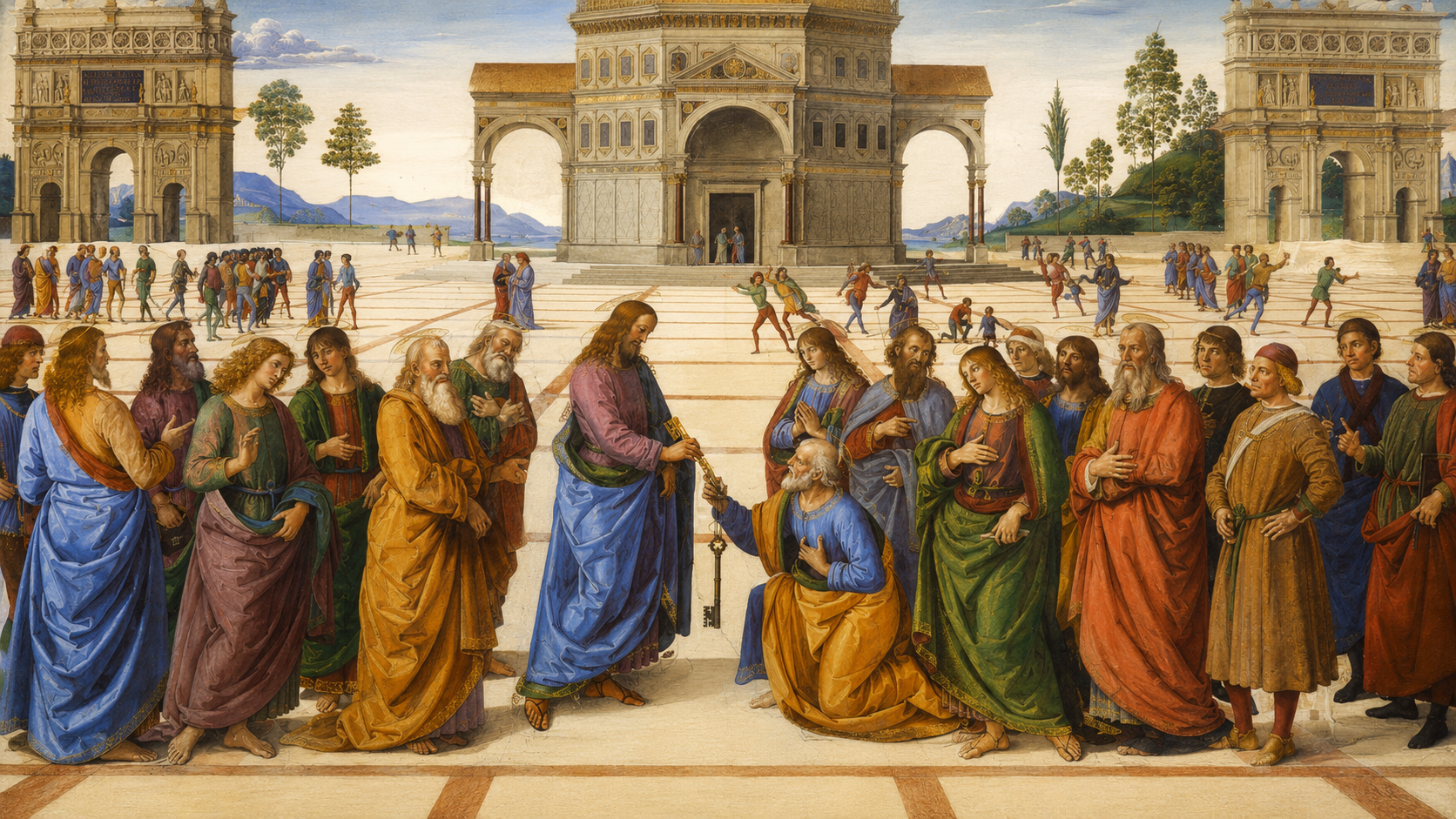
Peter is named first, receives a new name and the keys, is charged to strengthen his brethren and to feed the whole flock. In Acts he leads the replacement of Judas, preaches at Pentecost, judges the first disciplinary crisis, receives the Gentile mission and states the doctrinal principle at Jerusalem. None of these acts by itself supplies the entire later canonical structure. Together they establish a distinctive responsibility within the apostolic college.
The key question is whether this responsibility dies with Peter or belongs to the enduring constitution of a Church promised to all nations and ages. An office needed only during the apostolic generation would leave the later universal communion without a visible principle capable of final appeal and confirmation. Catholic tradition locates the succession of that office in the Roman See, where Peter and Paul bore witness and where the early Church repeatedly recognized a distinctive responsibility.
Clement of Rome intervenes in the Corinthian crisis while the Apostle John may still have been alive. Ignatius describes the Roman church in language of presidency. Irenaeus appeals to the succession and preeminent authority of Rome as a public norm against gnostic secret traditions. Cyprian, despite severe conflict with Pope Stephen, speaks of the chair of Peter and the principal church from which sacerdotal unity has arisen. Appeals to Rome, the reception of Leo’s Tome at Chalcedon and the Formula of Hormisdas show that Roman primacy cannot be reduced to a late medieval invention.
Historical exercise develops. Imperial politics, communication, canon law and crises affect the mode in which authority is used. Development of exercise, however, does not prove invention of substance. The correct comparison asks whether the earlier evidence contains a real universal responsibility capable of the later clarification, not whether a first-century administrative manual already uses every term of Vatican I.
Vatican I defines primacy and infallibility within strict limits. Infallibility is not personal impeccability, omniscience, inspiration or a guarantee attached to every sermon and policy. It concerns the preservation from error when the Roman Pontiff, acting as universal teacher, definitively binds the whole Church on faith or morals. The office exists to protect the deposit, not to create a new revelation or make contradiction true.
Historia et identitas
Development, crisis and the endurance of the same subject
Indefectibility does not promise an age without scandals, confusion or imprudent government. It promises that the Church cannot cease to be the Church Christ founded.
The historical record includes persecution, disputed elections, weak popes, political entanglement, local schisms, theological confusion and grave moral corruption. A credible Catholic account must not minimize these facts. Yet the relevant question is what endured through them. The creed, sacramental structure, apostolic orders, public succession, universal mission and Roman communion survive crises that destroyed many political institutions around them.
Doctrinal development is often confused with reversal. A genuine development makes explicit what was contained in the deposit, resolves a new question by principles already received and preserves prior definitions. A corruption changes the object, denies the former rule or uses ambiguity to make contradictory affirmations function as though both were binding. The Catholic tradition possesses internal tests for this distinction: Scripture and Tradition, the consensus and reception of the Fathers, the prior dogmatic definitions, the analogy of faith and the identity of the teaching subject.
This distinction is especially important in periods of ecclesial crisis. Fidelity does not require pretending that every policy, discipline, prudential judgement or non-definitive formula is beyond criticism. Nor does criticism authorize the believer to construct a private substitute church or to treat the ordinary means of unity as extinct. The Catholic response is to adhere to what has been certainly handed down, distinguish levels of authority, resist contradiction by the prior rule of faith and labour for correction within the visible Church.
Restorationist claims face a heavier burden. To say that the Church disappeared from public history for centuries and returned through a modern prophet or society conflicts with the promises attached to the apostolic mission, the Eucharist and the gates of hell. The claimant must then provide public divine credentials proportionate to the assertion and explain why God allowed the sacramental and doctrinal means established by Christ to vanish while preserving no identifiable succession. Private visions, disputed translations or failed chronologies cannot carry that burden.
Separation also differs in degree. Eastern churches retain true sacraments and apostolic succession but lack full communion with the Roman See. Communities of the Reformation preserve Scripture, baptism and many Christian truths while rejecting elements of sacramental and teaching authority. Restorationist bodies add claims of total apostasy and new revelation. A just ecclesiology recognizes the goods preserved without flattening the objective defects into one category.
Difficult questions
The strongest objections answered directly
These replies state principles. Each linked dossier develops the documentary case.
Objection 1. Christ founded a spiritual fellowship, while institutional Catholicism arose later.
The spiritual and visible are not rivals in the New Testament. Grace creates a body with baptism, Eucharist, offices, discipline, councils and mission. Later canonical precision develops the administration of realities already present; it does not transform a formless spirituality into its opposite.
Objection 2. The corruption of churchmen proves that the Catholic Church cannot be holy.
Holiness belongs first to Christ, doctrine, sacraments and the sanctifying end of the Church. Members can contradict the holiness they receive. Their sins require judgement and reparation, but the inference from sinful members to false doctrine is valid only where the doctrine itself commands the sin.
Objection 3. The true Church is the invisible totality of the elect across denominations.
God alone knows the elect, but Christ commands a visible profession, baptism, Eucharistic communion and obedience to pastors. The invisible life of grace cannot cancel the visible means by which He chose to communicate and guard it.
Objection 4. Rome possessed only a primacy of honour in the first millennium.
Honour is part of the evidence but does not exhaust it. Early interventions, appeals, doctrinal confirmation, the Roman succession used against heresy and the reception of Roman judgements require an account of real authority. The debate concerns its precise scope and exercise, not whether Rome was merely one honourable see among equal independent churches.
Objection 5. Doctrinal definitions prove that Catholicism changes its faith.
New vocabulary can protect an old object. The test is whether the definition follows from the deposit and excludes a contradiction that threatened it. Nicaea, Chalcedon and Trent show that refusing all later precision would leave the apostolic confession defenceless against new formulations of error.
Scripture is materially sufficient as inspired revelation, but the theory must still identify the canon, distinguish authentic interpretation from private contradiction and explain the apostolic teaching office described by Scripture itself. The book and the public society that received and transmitted it cannot be separated without historical circularity.
Objection 7. Many sincere Christians outside Rome show that visible unity is unnecessary.
Personal culpability differs from objective separation, but the distinction does not make error true. Catholic doctrines and valid sacraments found outside visible unity are derived from the apostolic inheritance; they do not prove that Christ intended contradictory communions as the normal form of His Church.
Objection 8. A modern restoration could fulfil prophecy despite the loss of historical succession.
A total restoration claim must be authenticated by public divine signs and must explain Christ’s promises of endurance. A later claimant cannot obtain authority merely by announcing that all prior authority vanished. The stronger the rupture claimed, the stronger the required evidence.
Ab Adam ad Ecclesiam · una historia salutis
The Catholic Church claims the whole unbroken line: primordial revelation, patriarchal worship, Israel, Christ and apostolic succession
She does not appear as a new religion detached from the beginning, but as the visible fulfilment and continuation of the one economy of revelation.
Adam and Eve receive command, judgement and promise. Abel offers sacrifice in faith. The line of Seth invokes the Lord. Noah emerges from judgement into covenant and altar. Melchizedek is priest of the Most High and blesses Abraham with bread and wine. Abraham receives promise for all nations. Israel receives law, sacrifice, priesthood, kingship and prophecy. Each stage preserves what came before while adding a divinely attested development.
Jesus does not abolish this history. He identifies Himself as its fulfilment: the true Temple, the paschal Lamb, the Son of David, the suffering servant, the new Moses and the mediator of the new covenant. His Resurrection is the public divine confirmation. He then chooses the Twelve in correspondence with the tribes, gives them authority to teach and forgive, institutes the Eucharistic sacrifice, commands baptism of the nations and promises His presence to the end of the world.
Pentecost makes the continuity visible. The apostles preach one doctrine, celebrate one breaking of bread, appoint ministers, judge disputes and send binding decisions. Their successors continue the same mission. The Church can suffer persecution, scandal, bad government and doctrinal confusion among her members, but she cannot disappear without making Christ’s promises false. A universal apostasy followed by a late restoration is therefore excluded by both divine providence and ecclesial indefectibility.
The Catholic identification is not based on size or cultural dominance. It rests on the convergence of the four marks: unity in faith, sacraments and government; holiness in doctrine, worship, grace and saints; catholicity in the universal mission; apostolicity in doctrine, orders and succession. The Roman see serves the final visibility of this communion because the Petrine office endures as a principle of unity among the successors of the apostles.
The line of true religion has therefore never vanished. It begins with mankind’s first relation to God, becomes publicly identifiable in the patriarchs and Israel, reaches its fullness in Christ, and remains historically visible in the Catholic Church. This continuity is not an ornament added to the proof; it is what the goodness, fidelity and providence of God require.
Verify the answer
Sources used to test the conclusion
The demonstration is anchored in the sources that define the Church before later ecumenical or sociological categories are introduced.
New Testament
Matthew 16 and 18; Luke 22; John 10, 17, 20 and 21; Acts 1–2, 6, 10 and 15; 1 Corinthians 10–12; Ephesians 2–4; 1 Timothy 3; 2 Timothy 1–2; Titus 1.
The one religion preserved from the beginning reaches its visible fulfilment in the Catholic Church
The conclusion rests upon continuity of revelation, the public acts of Christ, apostolic succession, the four marks and the promises of indefectibility.
The Catholic claim is not that every age of church history is equally luminous or that every decision of churchmen is prudent. It is that the same visible subject founded by Christ endures through every age with the apostolic faith, sacramental order and mission intact. Reform occurs within this subject; it does not require the invention of a replacement church.
The comparative path has now reached its end. Ancient religions preserve fragments but not the continuous revelation. Hindu and Buddhist systems arise as later, internally diverse paths without the covenantal line. Islam appears still later and contradicts the prior public revelation at its centre. Judaism carries the authentic root but is ordered toward the Messiah. In Christ the promise is fulfilled, and in the Catholic Church the apostolic mission remains visible.
The practical consequence is an obligation of conscience. Once the existence and attributes of God, the credibility of Christ and the identity of His Church are morally certain, religion is no longer a matter of private taste. The seeker must follow the truth discovered; the Catholic must live in fidelity, penance, worship and charity worthy of the gift received.
WHAT THIS MEANS FOR YOUR SEARCH
What should you conclude?
The Catholic case identifies one continuous subject through apostolic succession, Eucharistic worship, universal communion, doctrinal development and the Petrine office. Human sin requires reform within that Church; it does not require a later invisible substitute or total restoration.
This judgement concerns propositions and evidence, not the human worth of every person who holds them. Truth, personal culpability and pastoral charity must be distinguished without treating contradictory claims as equally true.