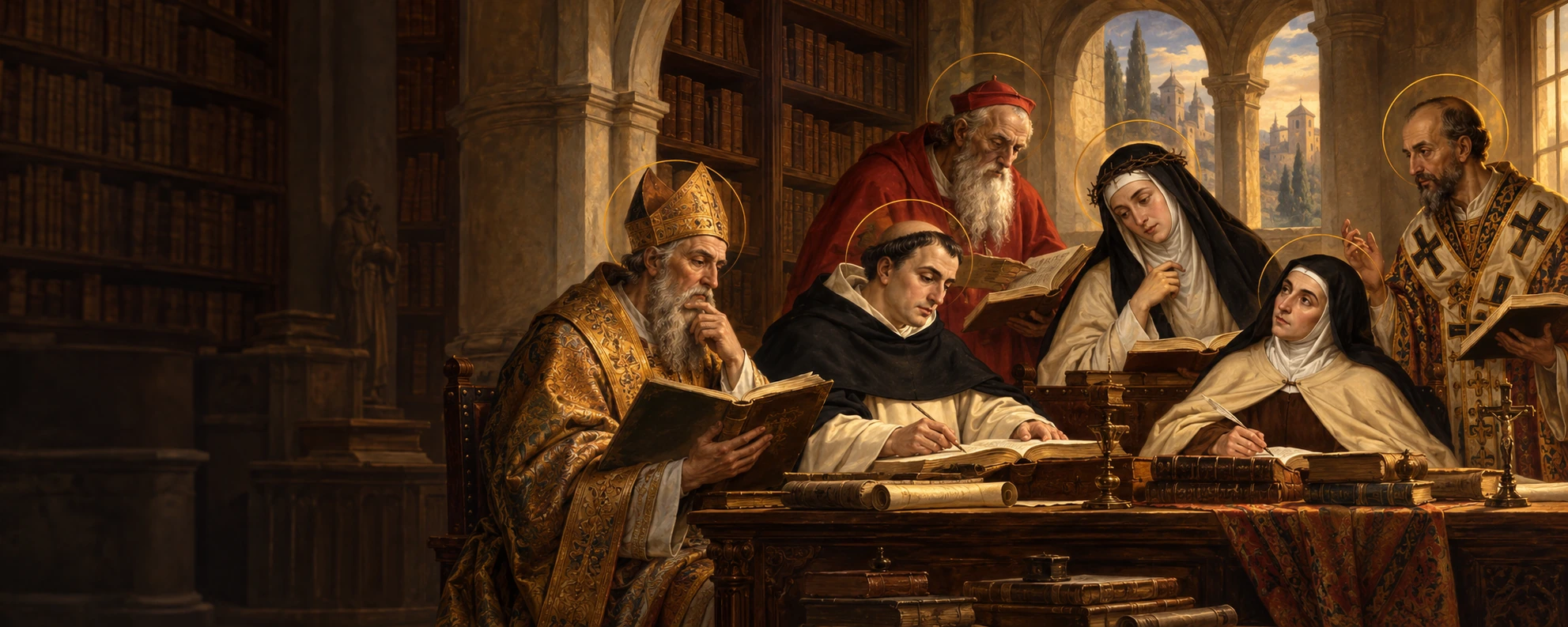
Doctores Ecclesiae · doctrine, sanctity and eminent learning

Doctors of the Church

The title “Doctor of the Church” is conferred upon saints whose holiness, eminent doctrine and enduring service to the universal Church are formally recognised. This is not a lexicon entry: the page below lists the Doctors themselves, connects them to the actual Church Fathers and Philosophers corpora, and opens every verified local work witness in the same original-and-translation reader.

Ecclesial title

Saints proposed as eminent teachers

The title does not create a new source of revelation and does not make every sentence of a Doctor individually irreformable. It recognises an outstanding and enduring doctrinal contribution within the communion and judgment of the Church. The works must therefore be read in their original literary form, historical setting and proper theological authority.

Catholon keeps the catalogue of Doctors distinct from the availability of local editions. A Doctor may be listed while no work has yet been imported; conversely, a work is shown as readable only when a verified local text witness is actually present.

Catalogue names, available translated work titles and controls follow the interface language. Bibliographical metadata and source texts remain in their original languages.

Reader discipline

Original, translation and source status

Greek, Latin, Syriac, Armenian and other source languages remain separate from vernacular editions. Missing translations are disabled. Technical TEI notices and absent-section messages are recorded once as source status and never printed repeatedly as if they were the Doctor’s own text.

Saint Thomas Aquinas retains the dedicated Summa reader, with a direct bridge from his Doctor entry.

Early witnesses · before AD 600

Read the early witnesses in their own texts

Athanasius of Alexandria · fourth century

In Defence of the Nicene Definition, especially chapters 19–27, Athanasius explains why the bishops used precise language to exclude an Arian reading of Scripture. He appeals to earlier teachers to show that the Nicene confession preserves the received faith. This is a witness to doctrinal continuity, not a claim that every later conciliar procedure already existed in 325.

Read Athanasius: Defence of the Nicene Definition, 19–27

Vincent of Lérins · AD 434

In the Commonitorium, chapters 2 and 23, Vincent joins fidelity to the Church's received faith with genuine growth in understanding, in the same doctrine, meaning and judgment. His distinction helps explain how councils clarify the apostolic deposit without introducing another revelation.

Read Vincent: Commonitorium, 2 and 23

38 Doctors

Select a work

Verified local editions open here.