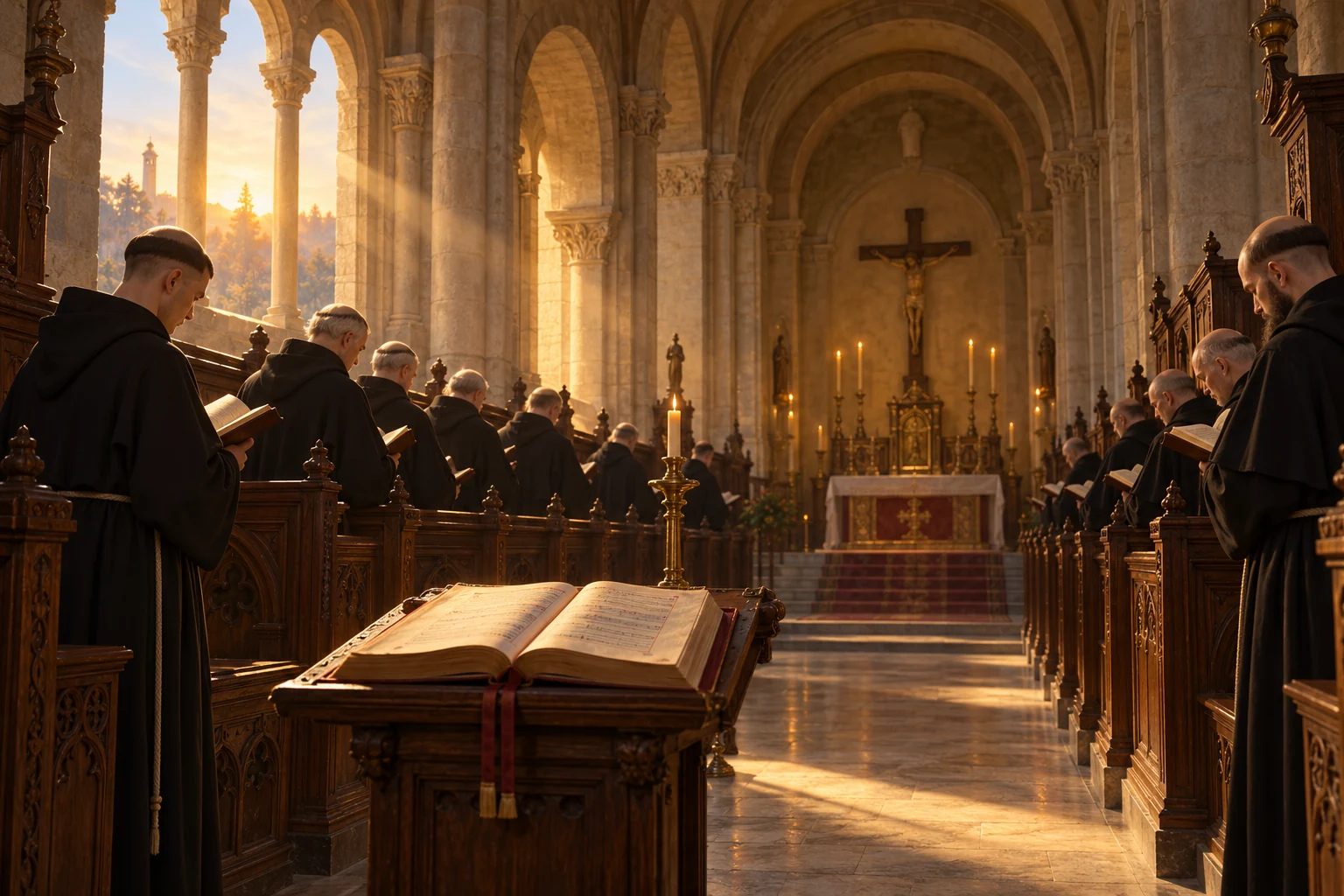
The Roman Breviary orders daily prayer in eight Hours, with psalms, readings, hymns and collects. This guide follows the 1960 rubrics and the traditional books associated with the 1962 Missal.
The Breviary is the public prayer of the Church: psalms, hymns, readings and collects distributed through the day. This guide explains how the hours belong together and leads to the reader below, where the eight hours can be opened for the selected date.
The eight hours guide prayer through the day. Their complete sequence is calculated for the selected date according to the Roman rubrics of 1960. The pictures and explanations below introduce the structure and spiritual meaning of the Divine Office.
The prayer of Christ’s Mystical BodyThe psalms are prayed with Christ, the Head, and with the whole Church.The hours return the day to GodNight, dawn, work, noon, evening and rest are placed within an ordered sacrifice of praise.
Matutinum
Matins
The nocturnal vigil: psalmody and lessons. Scripture, patristic homily and hagiography interpret the feast or season, making the Office a school of sustained ecclesial contemplation rather than a series of private readings.
Vigil, lessons and the long memory of the Church
The number and arrangement of nocturns vary by rank and day, but the fundamental movement remains: invitatory, psalms, absolutions, blessings, lessons and responsories. Responsories turn the readings into sung meditation.
Matins preserves the ancient Christian instinct to sanctify night and await the Lord. Even when anticipated by discipline, its texts retain the theology of vigil, judgment and expectation.
Morning praise at the coming of light. Lauds consecrates dawn through praise, Old Testament canticle, the Laudate psalms and the Benedictus. Natural light becomes a sign of creation, Resurrection and the coming day in which the Christian must serve God.
Morning praise and the Benedictus
The office moves from psalmody to chapter, hymn, Benedictus and collect. The canticle of Zachary gathers covenant, prophecy, forgiveness and the Dayspring from on high, making each morning a confession of fulfilled promise.
Lauds does not merely bless a biological routine. It places work, temptations and duties beneath the risen Christ and the Church's calendar.
The first hour consecrates the beginning of work. Prime stands at the threshold of work. Its hymn asks discipline of senses and speech, its psalmody places activity under divine law, and the Martyrology and chapter office historically connect prayer with the concrete duties and memory of the community.
The first hour, work and custody of the senses
Prime's distinctive value lies in joining contemplative recollection to the beginning of labour. The hour asks that words, looks and actions be guarded before the day's distractions acquire momentum.
The traditional office can include reading of the Martyrology and prayers for the work of the day. This makes the sanctoral memory and local community's obligations part of one disciplined beginning.
Short offices interrupt labour and recall divine grace. Terce, Sext and None interrupt labour at the third, sixth and ninth hours. Their brevity is theological: the day does not belong to work alone, and grace must repeatedly recollect the person to Pentecost, the Crucifixion and the death of the Lord.
Terce, Sext and None within the working day
Terce invokes the Holy Ghost; Sext confronts the heat and burden of midday; None turns toward perseverance and the hour of Christ's death. Repeated psalmody forms a rhythm of return rather than one isolated morning intention.
The hours teach that sanctification of time is not constant emotional intensity. Short faithful prayer can re-establish order within ordinary duty.
Evening thanksgiving with the Magnificat. Vespers gathers the completed day into thanksgiving through psalmody, hymn and the Magnificat. Evening light and incense recall creation and sacrifice, while Mary's canticle interprets history through divine mercy, reversal and covenant fidelity.
Evening thanksgiving and the Magnificat
The hour's psalms vary with day and feast, giving the evening a scriptural character rather than a generic mood. The Magnificat remains stable and places the Church's praise within Mary's response to the Incarnation.
Vespers also opens the liturgical observance of major feasts through first Vespers. Sacred time thus begins according to ecclesial rank and calendar, not merely the civil clock.
Examination, trust and protection before the night. Compline closes the day with examination, confession, psalmody and trust beneath divine protection. Night becomes an image of death and vulnerability, while the Nunc dimittis teaches peaceful readiness after beholding salvation.
Examination, protection and readiness for death
The office asks sobriety against the prowling enemy, confesses fault and invokes protection over body and dwelling. Its Marian antiphon changes with the season and extends the Church's trust into the night.
Compline forms a Christian habit of ending action in judgment and mercy. The day is not simply abandoned to sleep; it is returned to God with gratitude and contrition.
Prime stands at the threshold of daily work. Its hymn asks that the senses and tongue be restrained; its psalms place activity beneath the law of God; its brief reading and collect turn duty into service.
Pray the signs
Rubrics and marks
*
A pause or division in a verse.
†
A shorter flex or prescribed sign.
℣ / ℟
Versicle and response.
Red text
An instruction, not part of the recited text.
Use the reader
A practical method
Choose the date and source language.
Confirm the office or feast.
Keep Latin visible and use the vernacular for understanding.
In On the Lord’s Prayer 34–36, Cyprian connects prayer at the third, sixth and ninth hours with Scripture, and explains morning and evening prayer through Christ’s Resurrection and coming. These passages attest the sanctification of the day before the later Roman Breviary was assembled.
Chapters 8–20 of the Rule order night prayer, the daytime hours and the distribution of psalms, with reverence and attention in prayer. The Rule is a monastic witness to an ordered cycle of worship, not an assertion that the monastic and Roman secular offices were identical.