Religiones mundi · veritas, revelatio et salus

World Religions: Primordial Revelation, Historical Claims and the One True Religion

Religions cannot all be true where they contradict one another about God, creation, the human person, sin, worship and salvation. Comparison must therefore begin with objective truth and with the providential continuity of the knowledge and worship God gave mankind from the beginning.

The inquiry follows surviving remnants of ancient memory, the later Indian and Buddhist systems, the seventh-century claim of Islam, the covenantal history of Israel and, finally, the claim that this history is fulfilled in Jesus Christ and continued in His visible Church.

Comparative study of ancient gods, primordial memory and historical religions
Comparison begins with truth, chronology and the public signs by which a claimed revelation asks to be believed.

START HERE · FOR THE SEARCHER

Can contradictory religions all lead to the same eternal truth?

First identify the claim, the date of its controlling sources and the account it gives of God, man, moral law and the final end. Test it by reason and public history before comparing it with prior revelation, Jesus Christ and the apostolic Church.

1 · UNDERSTAND

What does this tradition claim?

This page compares the principal religious paths by asking what each says about God or ultimate reality, the human person, guilt and suffering, worship, death and salvation. It distinguishes isolated true propositions or inherited memories from the false cults and contradictory systems in which they may appear.
2 · WHY IT MATTERS

Why does this matter for eternity?

Religions offer incompatible answers about God, the person, worship, guilt, death and salvation. Sincerity deserves respect, but only truth can unite the person to the real Creator and give a hope stronger than death.

3 · WHERE THE EVIDENCE LEADS

What conclusion does the evidence support?

Some peoples and texts retain isolated natural truths or remnants of primordial tradition, but the religious systems built around them contradict one another. The final conclusion follows only after primordial revelation, Israel, the public claims of Jesus Christ and the apostolic witness have been examined.

READ IN THIS ORDER

  1. Learn what the tradition teachesBegin with its origin, authorities, view of God, view of the person, worship and promised salvation.
  2. Test its central claimsExamine coherence, chronology, primary sources and the strongest form of its own case.
  3. Compare the final answerAsk whether it truly reconciles the person to the Creator and corresponds to Christ’s public revelation.
OPTIONALSource notes and argument map · World Religions: Primordial Revelation, Historical Claims and the One True Religion

This optional layer verifies the conclusion instead of merely repeating it. It identifies the controlling terms, dates the decisive witnesses, links the primary texts and states which premise the strongest contrary case must deny.

TERMS AND SCOPE

What is being compared—and in what order

“World religions” is a field of comparison, not a single religion. You must first identify what each tradition claims about reality, revelation, the human person and the final end before asking whether those claims are coherent, historically warranted or compatible.

Open What is being compared—and in what order

CHRONOLOGICAL CONTROL

A chronology prevents the invention of one timeless “world spirituality”

2000–500 BC Covenant, temple cultures and Vedic religion Biblical revelation, Mesopotamian and Egyptian cults, Canaanite religion and the Vedic corpus develop in distinct historical settings. 600 BC–700 AD Philosophical schools, Buddhism, Christ and Islam Greek philosophical criticism, Upanishadic and Buddhist movements, the apostolic proclamation and the rise of Islam establish many of the enduring alternatives in metaphysics, worship and…

Open A chronology prevents the invention of one timeless “world spirituality”

Katholon readers and local dossiers lead to the exact primary text, translation, chronology and commentary required for verification; external links are supplementary, not substitutes for the local source chain.

Sources used to test the conclusion

Katholon readers and local dossiers provide the primary-text chain, translation, chronology and commentary required for verification; external links are supplementary only.

Open Sources used to test the conclusion

The strongest contrary case is stated in recognizable form and answered at the premise on which it depends; the section is not a note about editorial method.

The strongest objections answered directly

Each answer opens the reasoning behind the editorial method used throughout the publication.

Open The strongest objections answered directly

Argument map

  1. Claim to test. Can contradictory religions all lead to the same eternal truth?
  2. Why it matters. Religions offer incompatible answers about God, the person, worship, guilt, death and salvation. Sincerity deserves respect, but only truth can unite the person to the real Creator and give a hope stronger than death.
  3. Evidence-bearing step. The local readers, chronological dossiers and linked terms permit the visitor to verify the text, date, meaning and doctrinal consequence rather than rely on an external summary.
  4. Conclusion reached. Some peoples and texts retain isolated natural truths or remnants of primordial tradition, but the systems built around them contradict one another. The full Catholic conclusion follows from the public fulfilment of revelation in Jesus Christ and the visible apostolic Church.

Degree of certainty. Metaphysical contradictions can be judged by reason; dates, authorship and transmission receive historical degrees of certainty. The final religious judgement is cumulative: a later claim must not contradict truths already established by reason or a prior public revelation without proportionate evidence.

Comparative field dashboard

The principal religious traditions in historical order

Human beings in every age have asked where the world came from, whether there is one God or many gods, why evil and death exist, how man should worship, and what awaits him after death. The traditions gathered on this page did not arise at the same moment or from one common source. Ancient temple religions grew within cities and kingdoms; the Hindu traditions developed through many Indian texts and schools; Buddhism began with the teaching of Siddhārtha Gautama; Judaism is rooted in the history of Israel; Christianity begins with Jesus Christ and the apostles; and Islam arose in seventh-century Arabia around the preaching of Muhammad.

Each tradition is therefore introduced first through its own history, authorities, central beliefs, forms of worship and promised final end. Only after that basic account is clear does the page compare their claims by reason, chronology and public evidence. The cards below are a quick reference to the questions that remain constant throughout the comparison.

AT A GLANCE

Key facts to remember

Use these cards as a quick reference for origin, authorities, central beliefs, worship and historical development. The continuous overview above gives the basic story; the later sections examine the evidence in detail.

Corpus79 long dossiers

Fourteen comparative studies establish the common questions; sixty-five dossiers then test particular traditions and historical claims.

TraditionsSix principal paths

Ancient religions, Hinduism, Buddhism, Islam, Judaism and the Church of Jesus Christ are studied in a connected sequence.

First ruleContradictions matter

Two propositions that contradict one another cannot both be true in the same sense, even when their adherents are sincere.

Primary evidenceTexts before summaries

Scriptures, creeds, ritual sources, early witnesses and first-party institutional statements are distinguished from later descriptions.

Historical controlChronology before synthesis

The date, provenance, transmission and reception of a claim are established before it is placed in a timeless comparison chart.

Philosophical controlReality before preference

Metaphysics, causality, personhood, moral obligation and the possibility of revelation are tested by reason.

Theological controlRevelation is a public claim

The Catholic conclusion is not assumed at the first step; it is reached only after the claims of Christ and apostolic testimony are examined.

Pastoral controlPersons are not propositions

Objective contradiction, historical responsibility and personal culpability are never collapsed into one judgement.

The field from the inside

Every tradition should first be allowed to name its own sacred sources, authoritative teachers, forms of worship and account of salvation or liberation. A fair comparison does not begin by translating all religions into one modern theory of “spirituality.”

The controlling questions

The library compares ultimate reality, creation, revelation, authority, the human person, evil, worship, moral law and the final end. It then asks whether any claimed revelation is publicly identifiable in history and whether Jesus Christ can be reduced to one teacher among many.

Short chronology

  1. Natural knowledge of God, sacrifice, memory and myth precede the later organized traditions.
  2. Temple civilizations, civic cults and philosophical criticism create several distinct religious worlds.
  3. Israelite prophecy and the major Indian traditions develop within different historical and metaphysical frames.
  4. Jesus Christ and the apostolic Church make claims tied to public acts, witnesses and a visible community.
  5. Islam and later global encounters force new questions about prior revelation, continuity and contradiction.

Claim and historical setting

Claims, sources and historical reach

Begin with what each religion actually claims, the date and provenance of its controlling sources, and the account it gives of God, man, moral obligation and the final end. Antiquity, numbers, geographic breadth and moral discipline do not make contradictory propositions true. The first comparison therefore uses the same rules of reason and public history for every tradition; only afterwards does it compare the surviving claim with the earlier biblical revelation, Christ and the apostolic Church.

Begin by avoiding two opposite errors. Polemical reduction selects the strangest practice or weakest popular explanation and treats it as the essence of a tradition. Relativist description accumulates sympathetic facts but refuses to ask whether the central claims are coherent or true. A trustworthy comparison must do neither. It hears each religion from its primary texts, distinguishes periods and schools, and then submits propositions to the same standards of logic, metaphysics and historical evidence used elsewhere.

Religions are not interchangeable answers to one vague feeling. Some speak of a personal creator; others of an impersonal absolute; others refuse a creator question and diagnose existence through impermanence and craving. Some understand salvation as forgiveness and communion, others as liberation from rebirth, insight into non-self, obedience to revealed law or restoration of covenant. These accounts may share ethical or ascetical practices, but shared practices do not remove contradictory explanations of reality.

The Catholic position includes both recognition and decision. Any true proposition found outside the Church is true because reality is one; it may arise from natural reason, a remnant of primordial revelation, biblical borrowing or historical contact. Its presence does not confer divine authority upon the false religion surrounding it. Yet Christ is not one symbolic expression of an otherwise unknowable absolute. His Incarnation, death and resurrection are public claims, and the Church claims historical continuity with the apostolic witnesses. The decisive question is therefore whether another tradition confirms, anticipates, obscures or contradicts that revealed centre.

Proceed in this order. First fix the standards of truth and the possibility of revelation. Then compare authority, anthropology, moral law, worship and salvation. Only after this groundwork should one enter the detailed dashboards on Judaism, Islam, Hindu traditions, Buddhism and the religions of antiquity. The purpose is to reach a cumulative judgement strong enough to guide conscience, conversion and lifelong faith.

Historical method

A chronology prevents the invention of one timeless “world spirituality”

Texts, rituals and schools emerge in particular orders. Later syntheses must not be projected backwards or used to erase conflicts inside a tradition.

Before literate states

Religious universals and local memories

Burial, sacrifice, prayer, sacred kingship and moral taboo appear in many societies. Such recurrence may disclose features of human nature and traces of primordial revelation, but it does not prove that every myth descends unchanged from one source.

c. 2000–500 BC

Covenant, temple cultures and Vedic religion

Biblical revelation, Mesopotamian and Egyptian cults, Canaanite religion and the Vedic corpus develop in distinct historical settings. Comparison must be exact enough to identify both genuine analogies and profound differences.

c. 600 BC–700 AD

Philosophical schools, Buddhism, Christ and Islam

Greek philosophical criticism, Upanishadic and Buddhist movements, the apostolic proclamation and the rise of Islam establish many of the enduring alternatives in metaphysics, worship and salvation.

Medieval worlds

Commentary, law, mission and civilizational encounter

Rabbinic, Christian, Islamic, Hindu and Buddhist traditions elaborate canons, schools and institutions. Encounters include translation and argument as well as war, political inequality and mutual misunderstanding.

Modernity

Historical criticism and global religious exchange

Printing, colonial power, archaeology, comparative philology, reform movements and mass migration expose traditions to new scrutiny. Some modern forms are deliberate reconstructions rather than simple survivals.

Present task

From information abundance to ordered judgement

Digital access makes primary sources widely available, but abundance without method produces quotation wars. The sources must therefore be connected to chronology, authority and the precise claim they support.

How to reach a judgement

Understand, test, then answer

The descriptive profile and chronology above are not yet an apologetic conclusion. They establish what the traditions claim and when those claims become historically visible. The inquiry now separates what unaided reason and public evidence can test from what follows only after the Christian revelation itself has been examined.

FIRST QUESTION · REASON AND PUBLIC HISTORY

What can reason and public history establish?

The first comparison is not a contest of private experiences. It asks whether a religious worldview is internally coherent, metaphysically adequate, morally intelligible and proportionately supported by the kind of evidence its claims require.

1

Contradiction cannot be dissolved into “many paths”

Religions can share prayers, ascetic practices, moral prohibitions or symbols while contradicting one another about the most basic questions. A personal Creator and an impersonal absolute are not the same kind of reality. The enduring human person and the denial of any enduring self cannot both be true in the same sense. A once-for-all incarnation in public history is not equivalent to recurring manifestations within a cosmic cycle.

Fair comparison therefore begins by stating propositions precisely. Respect for believers does not require the suspension of logic; it requires refusing caricature while allowing genuine contradictions to remain visible.

2

The account of ultimate reality must explain intelligence, freedom and order

A religious system should explain why contingent beings exist, why the world is intelligible and why rational minds can know truth. An ultimate principle that is less than intelligent or personal must still account for personal intelligence, free agency and the directed order found in finite beings. A plurality of finite gods does not terminate the question of dependence; each member of the plurality still requires an explanation.

Natural theology does not by itself prove every Christian doctrine, but it narrows the field. It points toward one necessary, intelligent and free first cause distinct from the world, and it rules out explanations that merely rename the dependent order instead of grounding it.

3

A theory of salvation depends upon a true account of the person

Karma, rebirth, enlightenment, legal submission, covenant fidelity and sacramental grace answer different diagnoses of the human problem. Before comparing remedies, the inquiry must ask who or what is saved. Moral responsibility becomes unstable if no enduring subject bears action and consequence; personal communion becomes unintelligible if individuality is only an appearance; forgiveness loses its meaning if evil is reduced to ignorance alone.

The unity of body and rational soul, the persistence of personal identity, objective moral obligation and the finality of death are therefore not secondary themes. They determine whether a proposed religious end perfects the person or explains the person away.

4

Public revelation carries a public burden of proof

A claim that God has spoken in history must be located in time, transmitted through identifiable witnesses and accompanied by signs proportionate to its authority. Private illumination may transform the recipient, but it cannot by itself oblige all mankind. A later claimant who corrects an earlier public revelation must explain the earlier documents, witnesses and communities rather than simply declare them corrupted.

Chronology is therefore part of rational judgement. Textual history, independent attestation, the relation between earliest and later sources, fulfilled prophecy and the public consequences of a founding event all matter. Historical inquiry cannot manufacture supernatural faith, but it can show whether assent is responsible or whether the claim survives only by insulating itself from evidence.

5

Natural religious truths are real but incomplete

Across cultures one finds sacrifice, prayer, moral law, judgement, purification, providence and the intuition that visible goods do not satisfy the human end. These convergences are significant. They can witness to natural knowledge of God, inherited memory and the permanent structure of the human person.

Yet convergence is not identity. The same themes are frequently embedded in incompatible cosmologies and false cults. Stage I therefore separates a true proposition or inherited memory from the religious system that appropriates it; the presence of one true statement cannot authenticate the system joined to it.

SECOND QUESTION · THE FULL CATHOLIC ANSWER

What does Christ and the Catholic faith answer?

The second stage does not begin by treating Catholic authority as a premise. It begins with the historical and theological claim reached through Christ: the Creator who can be known by reason has acted publicly, prepared mankind through covenant and prophecy, and founded a visible sacramental communion.

1

Creation and primordial revelation explain both convergence and degeneration

Natural reason explains why peoples can retain certain truths: all men share the same created nature, can know something of God from His works and may inherit remnants of primordial revelation. Such truths arise from reason or an earlier tradition; they do not come from the false cult as false, and they confer no divine authority upon the errors joined to them.

This account explains why religions can preserve real goods without being interchangeable. Truth is received from creation and providence; error enters through ignorance, sin, cultural accumulation and false worship. Recognition therefore leads to discernment, not to a theory that contradiction is itself divine diversity.

2

Israel supplies a public, historical preparation rather than a timeless myth

The biblical covenant unfolds through named persons, law, sacrifice, prophecy, exile, return and messianic expectation. Its claim is not that every ancient cult is one symbolic expression of the same absolute, but that the one Creator purifies worship and directs a particular history toward a universal blessing.

The continuity of promise gives the Christian claim a historical grammar. Creation, Abraham, Moses, the prophets and the hope of a new covenant form an intelligible sequence against which later fulfilment can be judged.

3

Jesus Christ is not one teacher among many

The decisive Catholic claim concerns the identity and acts of Jesus: His authority, miracles, death and Resurrection, and the apostolic interpretation of those events. The Incarnation unites the divine and human without confusing Creator and creature; redemption heals guilt and nature without abolishing the person.

Because the claim is tied to public acts, witnesses and an early community, it can be examined historically in a way that differs from a purely interior realization. If the Resurrection is credible, religious comparison acquires a centre that later systems must face rather than merely absorb.

4

The apostolic Church preserves doctrine, sacrament and mission together

Christ does not leave revelation as a detached text awaiting reconstruction. The apostolic community preaches, baptizes, celebrates the Eucharist, appoints ministers, judges disputes and hands on a rule of faith before the New Testament canon is finally delimited.

The Catholic Church claims continuity with this visible subject through episcopal succession, sacramental worship, ecumenical dogma and the Petrine service of unity. The Church is therefore part of the evidence for the revelation, not a later optional container around it.

5

Fragments of natural truth do not authenticate a false religion

A true proposition remains true wherever it is uttered, but its presence does not sanctify the false religion that surrounds it. Such fragments may come from natural reason, primordial memory or borrowing from earlier revelation. Personal culpability may vary; the objective contradiction with truth does not.

Catholic charity requires justice toward persons, exact refutation of error and an open call to conversion. It rejects both forced assent and the indifferentist claim that false religions possess equal rights before truth.

Continuity synthesis

Revelatio primordialis · providentia · continuatio

The first test of a universal religion is continuity with the revelation given from the beginning

A religion that claims to be the saving truth for all mankind cannot begin as an isolated correction after the true worship of God has vanished from history.

The philosophical demonstration of God does more than establish a first cause. It reaches a cause that is intelligent, good, provident and the final end of rational creatures. Such a God does not create mankind for truth and beatitude and then leave every generation without a real relation to that end. Even after the Fall, the public line of worship is not extinguished. Scripture places sacrifice and divine judgement at the beginning of human history: Adam and Eve receive command and promise; Abel offers an accepted sacrifice; the line of Seth invokes the name of the Lord; Noah receives covenant and blessing after the Flood; Melchizedek appears as priest of the Most High; Abraham is called into a public covenant; Israel receives law, priesthood, prophecy and Temple; Christ fulfils the promise; the apostolic Church carries it to the nations.

This continuity does not mean that every people possessed the same explicit knowledge or that every individual outside the visible covenant was without grace. It means that the true public religion was never wholly absent from the earth. God’s goodness and providence are incompatible with the theory that mankind was left for centuries with nothing but false worship until a merely human founder rediscovered the truth. Natural law remained written in the heart; the memory of creation, judgement, sacrifice and promise survived in fragments; and a determinate line of revealed worship continued through the patriarchs and Israel.

The chronological test is therefore decisive when it is stated correctly. A later movement can be true only as a divinely authenticated fulfilment, development or application of what God had already revealed. It cannot be the universal religion if it simply appears in one region, contradicts the prior revelation and supplies no public divine sign joining it to the original line. Historical lateness is not a trivial circumstance: when a religion claims to be the first or final saving truth but cannot trace its worship to the primordial revelation or to an authenticated fulfilment of it, that universal claim is false.

I · Creation

One Creator and one human origin

All men share one nature, one moral law and one final end; truth cannot be locally contradictory.

II · Promise

Revelation after the Fall

The first parents receive judgement and promise; sacrifice and invocation continue among the just.

III · Covenant

Noah, Abraham and Israel

The public line becomes historically identifiable through covenant, priesthood, law, prophecy and worship.

IV · Fulfilment

Christ and the apostolic Church

The final claim must fulfil the prior revelation, not deny its central public acts or require a total apostasy.

The method is therefore cumulative and exclusive: each proposition is judged as true or false, while the one true religion must possess objective truth, public divine authentication and providential continuity from the first revelation to its fulfilment.

Difficult questions

The strongest objections answered directly

Each answer opens the reasoning behind the editorial method used throughout the publication.

1

Why not say that all religions are different paths to the same summit?

The image assumes in advance that the paths share one destination.

Open reply

Objection stated at full strength. Religions can be culturally distinct expressions of one ineffable reality; contradiction belongs only to the surface.

Catholic reply. Some differences concern the ultimate itself: personal creator or impersonal absolute, one life or rebirth, Incarnation or its denial. These cannot all be surface descriptions of the same proposition.

Necessary distinction. Distinguish mystery, which exceeds comprehension, from contradiction, which destroys intelligible assertion.

2

Does Catholic fulfilment theology merely disguise superiority?

Fulfilment makes a real claim about truth and history.

Open reply

Objection stated at full strength. To say that another religion is fulfilled in Christ refuses to accept it on its own terms.

Catholic reply. A tradition’s own claims must indeed be heard. Yet no claimant possesses a right to immunity from judgement. Fulfilment receives genuine preparation while correcting error and locating every partial good within the one divine economy.

Necessary distinction. Distinguish understanding a claim on its own terms from accepting its truth.

3

Can a person be saved without explicit Catholic faith?

Subjective responsibility and objective means of salvation must be distinguished.

Open reply

Objection stated at full strength. If salvation is possible outside visible membership, mission is unnecessary.

Catholic reply. Every salvation is through Christ and ordered to his Church. God can apply grace beyond visible boundaries, while ignorance may lessen guilt; this does not make error salvific or remove the duty to preach the fullness of revealed truth.

Necessary distinction. Distinguish the person’s culpability from the truth or error of a religious system.

4

Why use non-Christian primary sources in Catholic apologetics?

Justice and accuracy are conditions of credible refutation.

Open reply

Objection stated at full strength. Quoting another religion gives it an authority Catholics should not concede.

Catholic reply. A source can be historically authoritative for what a community teaches without being divinely inspired. Direct reading prevents false attribution and reveals internal debates that secondary polemics often conceal.

Necessary distinction. Distinguish documentary authority within a tradition from supernatural inspiration.

Verify the answer

Sources used to test the conclusion

Katholon readers and local dossiers provide the primary-text chain, translation, chronology and commentary required for verification; external links are supplementary only.

1896 and 1928 · magisterial source

Satis cognitum and Mortalium animos

Leo XIII and Pius XI

Truthful charity toward persons joined to the Church’s duty to confess one divinely revealed religion and to invite all nations into the unity founded by Christ.

Read the document in its historical context and distinguish its defined proposition from later commentary.

Open document or internal reader

1928 and 1943 · magisterial source

Mortalium animos and Mystici Corporis Christi

Pius XI and Pius XII

The unique saving mediation of Christ and the identity, visibility and unity of the Church He founded.

Read the document in its historical context and distinguish its defined proposition from later commentary.

Open document or internal reader

1926 and 1928 · magisterial source

Rerum Ecclesiae and Mortalium animos

Pius XI

The missionary duty of the Church and the conversion of peoples, joined to a clear confession of the one true faith.

Read the document in its historical context and distinguish its defined proposition from later commentary.

Open document or internal reader

Catechism: the Church and non-Christians

Doctrinal orientation on Israel, Muslims, religious seeking and salvation.

Open source

Scripture reader

Creation, covenant, wisdom, Gospel and apostolic witness in parallel readers.

Open source

Natural theology

The philosophical foundation needed before revelation claims are compared.

Open source

Scripture reader

Primary or Katholon reader route.

Open source

Church Fathers

Primary or Katholon reader route.

Open source

Magisterium

Primary or Katholon reader route.

Open source

Church History

Primary or Katholon reader route.

Open source

Summa Theologiae

Primary or Katholon reader route.

Open source

Complete dossier dashboard

Further dossiers: documentary studies and primary-source trails

These dossiers prepare the reader to study each religion without flattening its distinct history or surrendering the demand for truth.

The landing page above states the principal argument in full. The dossiers below are the documentary second layer: each isolates a narrower historical, philosophical or theological question and supplies the longer source trail.

Religiones mundi · veritas, revelatio et salus

Truth, Contradiction and Religious Claims

Can contradictory religions be equally true in the same respect?

Long-form dossier

How apparently similar religious language can conceal incompatible assertions about reality.

Religious mystery exceeds finite comprehension, but it does not suspend the principle of non-contradiction; propositions about God, world, man and salvation remain capable of truth or falsity.

Religiones mundi · veritas, revelatio et salus

Primordial Revelation and Natural Religion

Do widespread religious universals preserve natural knowledge, a primordial revelation, degeneration, or independent invention?

Long-form dossier

What universal religious patterns can and cannot establish about humanity’s first knowledge of God.

Human reason can know God from creation and Catholic tradition permits a primordial revelation to the first parents, but comparative similarities require careful historical judgement rather than an imagined universal esoteric religion.

Religiones mundi · veritas, revelatio et salus

God, Ultimate Reality and Creation

What kind of ultimate principle can adequately explain contingent, intelligible and ordered reality?

Long-form dossier

Personal creator, impersonal absolute, divine multiplicity and non-theistic accounts compared at the metaphysical root.

The first principle must possess actuality, intelligence and causal independence; accounts that identify the ultimate with the changing world, reduce it to an impersonal abstraction or omit it altogether leave essential features of being unexplained.

Religiones mundi · veritas, revelatio et salus

Revelation, Prophecy and Miracle

What signs make a claim of revelation credible without making faith a blind leap?

Long-form dossier

Criteria for distinguishing divine speech from insight, charisma, legend and political authority.

A credible revelation must be worthy of God, coherent with truths already known, publicly identifiable through prophecy and miracle, and transmitted by witnesses and an authority capable of preserving its content.

Religiones mundi · veritas, revelatio et salus

Scripture, Tradition and Religious Authority

How should a religious text be identified, transmitted and authoritatively interpreted?

Long-form dossier

How canons arise, commentaries govern meaning and institutions claim the right to teach.

A sacred text cannot interpret or canonize itself; historical communities receive, transmit and delimit texts, while a universal revelation requires an authority that can preserve its authentic meaning without arbitrary innovation.

Religiones mundi · veritas, revelatio et salus

The Human Person, Soul and Final End

What is a human person, and what good can finally fulfil him?

Long-form dossier

Body, consciousness, personal identity and destiny across competing religious anthropologies.

The human being is one substantial unity of body and rational soul, created in the image of God and ordered to truth, love and resurrection; reduction to matter, aggregates or a manifestation of an impersonal self cannot preserve the whole evidence of personal agency and dignity.

Religiones mundi · veritas, revelatio et salus

Sin, Karma, Ignorance and Suffering

Is humanity’s deepest problem guilt before God, karmic consequence, metaphysical ignorance, disordered craving, or social alienation?

Long-form dossier

Four diagnoses of the human predicament and their very different moral logics.

Ignorance and craving are real dimensions of disorder, and acts have consequences, but the biblical category of sin uniquely identifies personal rupture with God and therefore the need for forgiveness, grace and redemptive reconciliation.

Religiones mundi · veritas, revelatio et salus

Salvation, Grace, Liberation and Enlightenment

Can the major religious accounts of salvation be treated as interchangeable symbols?

Long-form dossier

What is saved, from what, by whom and into what final state?

The answers differ at every decisive point: the identity of the person, the nature of evil, the agent of deliverance and the final end. Catholic salvation is gratuitous participation in divine life through Christ, perfecting nature in personal communion and resurrection.

Religiones mundi · veritas, revelatio et salus

Worship, Sacrifice, Prayer and Mediation

Are all sincere acts of worship directed to the same God regardless of doctrine and rite?

Long-form dossier

Why ritual form, object and authority matter in comparative religion.

Sincerity is morally significant but does not determine the object of an act. Divine worship belongs to the one creator, and the perfect sacrifice and mediation of Christ judge and fulfil every human religious aspiration.

Religiones mundi · veritas, revelatio et salus

Christ, the One Mediator and the Religions

Can Christ be confessed as unique while other religions remain independent salvific paths?

Long-form dossier

Why the Incarnation cannot be reduced to one manifestation among many.

Because the eternal Word truly became man, died and rose for all, his mediation is ontologically and historically unique; whatever grace reaches any person does so through him and is ordered to the communion he established.

Religiones mundi · veritas, revelatio et salus

Conscience, Ignorance and Salvation

What can be said about persons who do not know the Gospel or adhere to another religion in good faith?

Long-form dossier

How subjective responsibility is judged without making error a saving path.

God judges every person justly according to grace, knowledge and freedom; inculpable ignorance can diminish guilt, yet salvation remains through Christ and error itself neither sanctifies nor creates a parallel covenant.

Religiones mundi · veritas, revelatio et salus

Mission, Conversion and Civil Toleration

How should the Church proclaim truth, seek conversion and judge civil toleration without coercing the act of faith?

Long-form dossier

Truthful controversy, missionary proclamation and civil toleration without forced assent or religious indifferentism.

Doctrinal discussion may remove misunderstanding and expose the real point of disagreement, but it is subordinate to truth and mission. Faith cannot be manufactured by force; error has no moral right as error; and civil toleration may be permitted for the common good without treating contradictory religions as equal paths to God.

Religiones mundi · veritas, revelatio et salus

Comparative Morality and Natural Law

Do moral similarities prove equal revelation, and can moral disagreement be judged across cultures?

Long-form dossier

Shared precepts, divergent foundations and the test of difficult cases.

Natural law explains broad moral convergence because human nature and basic goods are common, while sin, custom and false metaphysics explain divergence; revealed morality confirms and elevates rather than invents the moral order.

Religiones mundi · veritas, revelatio et salus

History, Memory and Public Evidence

Can historical methods contribute to a judgement about revelation without pretending to prove grace as a laboratory fact?

Long-form dossier

Why claims rooted in datable events differ from timeless myth or private realization.

Historical inquiry can establish texts, events, witnesses and explanatory comparisons; while it cannot force supernatural faith, it can identify the public signs and remove alternative accounts that would make Christian assent irrational.

Visual study

Images, maps and documentary witnesses

The visual reader now follows the History atlas pattern: choose a study card, inspect the enlarged panel and open the full image without leaving the argument.

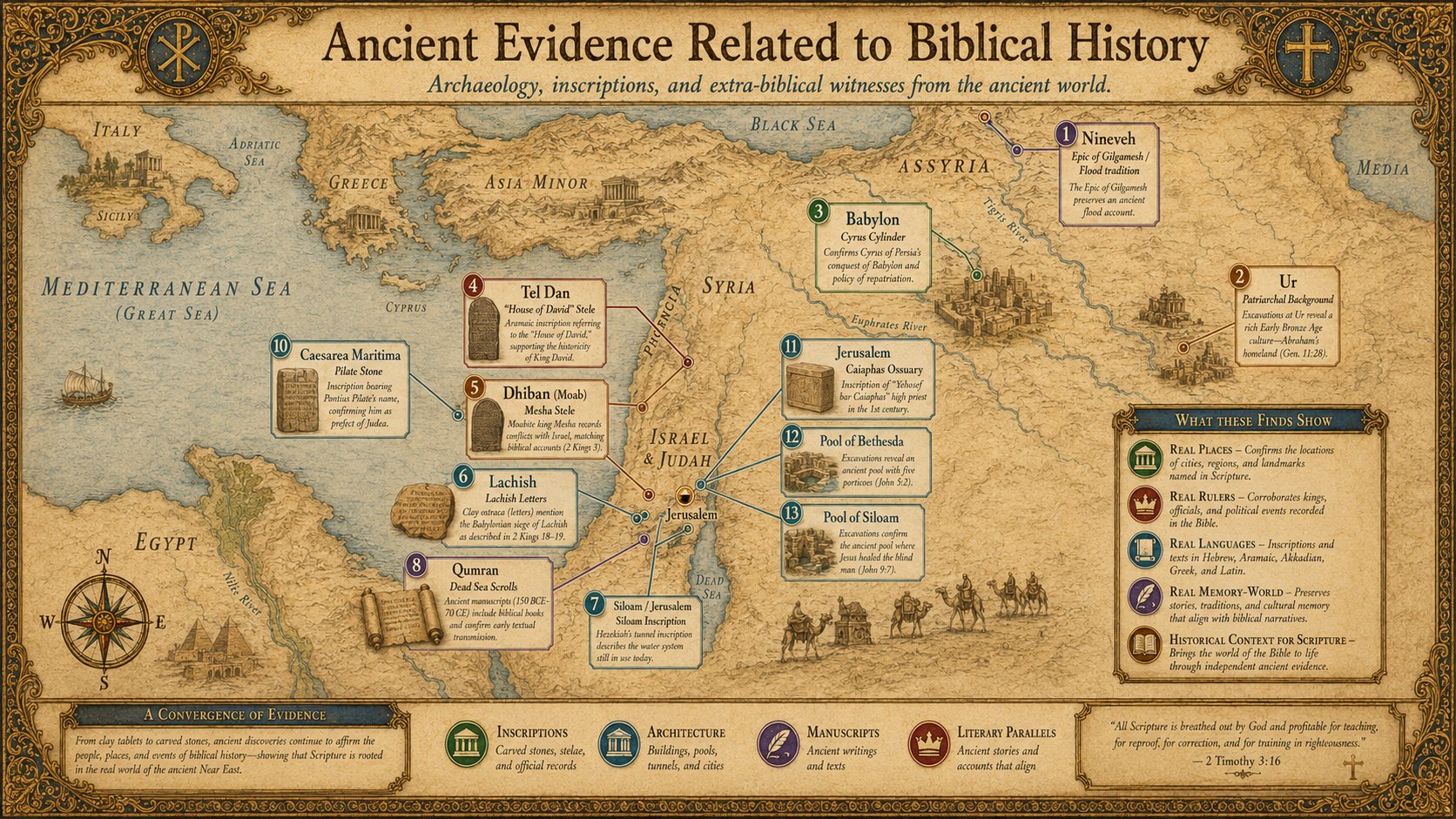
Ancient Evidence Related to Biblical History
Ancient Evidence Related to Biblical HistoryArchaeology and public memoryInscriptions, cities and material witnesses belong to historical apologetics when their evidentiary limits are stated and the biblical claim is not reduced to one artefact.

From comparison to judgement

Comparison reaches its proper end in a decision about Christ

The study of religions becomes Catholic apologetics when the reader can state each position fairly, identify the decisive contradiction, test the evidence and see why the truth found elsewhere is completed rather than destroyed in Christ. The next step is to enter each historical tradition through its own dashboard and primary-source dossier sequence.

Return to Apologetics

WHAT THIS MEANS FOR YOUR SEARCH

What should you conclude?

Some peoples and texts retain isolated natural truths or remnants of primordial tradition, but the religious systems built around them contain mutually contradictory claims. The complete conclusion is reached only after Israel, the public claims of Jesus Christ and the apostolic witness have been examined.

This judgement concerns propositions and evidence, not the human worth of every person who holds them. Truth, personal culpability and pastoral charity must be distinguished without treating contradictory claims as equally true.