Historical Dossiers · English edition

The Reformation and Catholic renewal

1517–1648

Sixteenth-century Catholic renewal joined doctrinal clarity to the rebuilding of pastoral life. Trent defined the Church’s teaching on grace and the sacraments, while bishops and religious communities founded seminaries, taught the faith, renewed prayer and expanded missions. That work answered genuine failures in discipline without surrendering the received faith. The chapters follow the controversy from indulgences to ecclesiastical rupture and then examine what Catholic reform established in parishes, schools and religious life.

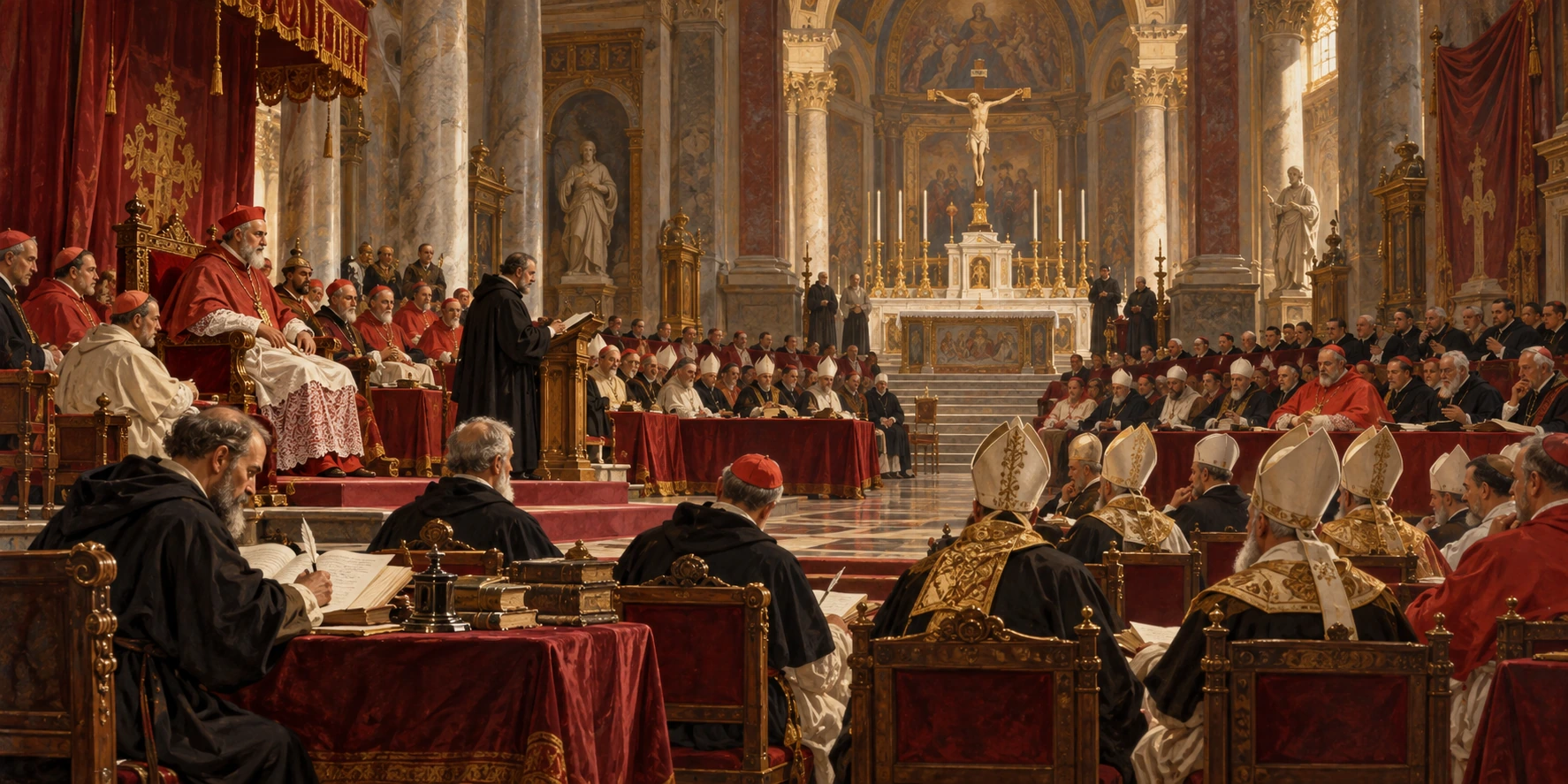
Bishops and theologians deliberating at the Council of Trent, 1545–1563
Bishops and theologians deliberating at the Council of Trent, 1545–1563.
3Long-form chapters3Disputed questions10Internal source connections

Historical geography · 1517–1584

Reformation and Catholic renewal: controversy, doctrine and pastoral work

The sequence begins in central Europe and then follows different routes through Zurich, England and the Nordic kingdoms. Trent forms a second centre: its sessions connected doctrinal definitions with obligations for bishops and clergy. Milan, religious foundations and schools show how decrees became pastoral work. Political settlements appear alongside these reforms because the survival of a confession depended on families and parishes as well as the decisions of rulers.

The story through1517Move the timeline to reveal events
Earlier events stay visible as the story unfolds.
Reformation and Catholic renewal: controversy, doctrine and pastoral workWittenberg · 1517Luther’s indulgence controversy
Conflict / siegeAssembly / settlementSchool / scholarshipCharter / law / decreeCouncil / synodMonastery / religious houseChurch / pastoral renewal

14 dated records · 4 historical periods

Link to this view

Move the timeline to reveal events in date order; previous events remain visible. Select a numbered badge to separate nearby records. Fine leader lines connect displaced symbols to their locations. Drag to move the map; use +/− to zoom. Left/Right changes year and Home fits the focused map. Dashed connections are schematic, and city locations are approximate.

Chronological index · all 14 dated records
  1. 01 · 1517 · WittenbergLuther’s indulgence controversy → chapter 1

    Martin Luther circulated propositions concerning indulgences, repentance and preaching in 1517. The controversy began within a Church whose doctrine distinguished forgiveness of guilt from the remission of temporal punishment. Abusive fundraising or misleading preaching did not settle the underlying doctrinal question. Wittenberg marks the beginning of an escalating dispute, not the instant appearance of every later Protestant position. The familiar account of a public nailing is unnecessary to identify the historically significant circulation of the theses.

  2. 02 · October 1518 · AugsburgLuther meets Cardinal Cajetan → chapter 1

    Luther’s meeting with Cardinal Cajetan brought the indulgence controversy before a papal representative. Questions of retraction and ecclesiastical judgment revealed that the dispute was no longer merely a complaint about a preacher’s conduct. Augsburg locates an attempted institutional response before the definitive rupture. Correcting abuses did not require acceptance of propositions contrary to received teaching. The attempted settlement at Augsburg concerned that distinction, before the controversy developed into a definitive rupture.

  3. 03 · 1519 · LeipzigThe Leipzig disputation → chapter 1

    Johann Eck’s disputation with Luther and Andreas Karlstadt moved questions about papal and conciliar authority into the foreground. Luther’s statements concerning condemned propositions associated with Jan Hus intensified the controversy. A university debate thus had consequences far beyond academic exercises. Leipzig explains why subsequent Catholic judgments addressed the Church’s authority to teach, not simply a financial scandal. The internal patristic sources provide the dossier’s doctrinal background; the disputation’s particular acts require their own historical evidence.

  4. 04 · 15 June 1520 · RomeExsurge Domine → chapter 1

    Leo X’s Exsurge Domine censured a series of propositions and called for their rejection. The bull belongs to a dispute now encompassing authority, sacramental doctrine and the Christian life. Its legal and doctrinal action should be distinguished from the subsequent imperial proceedings at Worms. Rome represents the papal judgment, while the spread of Luther’s writings and political protection involved additional centres. Defending this authority does not require treating every late medieval practice as immune from legitimate reform.

  5. 05 · April–May 1521 · WormsLuther before the imperial diet → chapter 1

    At the Diet of Worms, Luther appeared before Charles V and the imperial estates and declined the demanded recantation. The later Edict of Worms imposed imperial penalties. Ecclesiastical judgment and imperial enforcement were related but distinct acts, and political protection helped prevent a simple enforcement outcome. This marker explains the controversy’s territorial consequences without drawing an imaginary line between uniformly Catholic and Protestant populations. The loss of communion emerged through decisions by rulers, cities, preachers and communities.

  6. 06 · 13 December 1545 · TrentoThe Council of Trent opens → chapter 2

    The Council of Trent opened under Paul III after repeated obstacles to a general council. Its work would proceed in separate periods under changing political conditions rather than continuously for eighteen years. Trento became a place where doctrinal controversy and reform of pastoral government were addressed together. The opening therefore marks an institutional process, not the immediate settlement of every issue. Later sessions must be read with their own dates and subjects to understand the council’s response.

  7. 07 · 13 January 1547 · TrentoDecree on justification → chapter 2

    Trent’s sixth session defined justification through a decree and canons. The text affirms that grace precedes and enables conversion, while forgiveness includes the sinner’s inward renewal. Human cooperation is not an independent achievement competing with God. Its account of faith, hope, charity and perseverance explains why the Catholic response cannot be reduced to salvation by unaided works. The marker directs readers to the actual decree, where disputed formulations receive a more precise treatment than later polemical slogans.

  8. 08 · 1562 · ÁvilaTeresa founds Saint Joseph’s Carmel → chapter 3

    Teresa of Jesus founded the reformed Carmel of Saint Joseph at Ávila with episcopal support. Prayer, poverty and a disciplined community were the immediate purposes of the foundation. This was Catholic renewal through contemplative life, not simply a tactical response to Protestant political advances. Its location beside Trent in the chronology helps distinguish a shared ecclesiastical movement from direct institutional dependence. Women’s religious initiative belongs within the period’s history of reform as an active and enduring contribution.

  9. 09 · 17 September 1562 · TrentoTeaching on the sacrifice of the Mass → chapter 3

    The twenty-second session taught the sacrificial character of the Mass and its relation to Christ’s sacrifice on the Cross. The council did not posit a second redeemer or a fresh death of Christ at every celebration. It also addressed abuses in celebration, linking doctrinal definition to pastoral discipline. This combination is central to the dossier’s Catholic argument: reforming conduct and defending the sacrament were complementary tasks, rather than an admission that the received Eucharistic faith had been invented.

  10. 10 · 15 July 1563 · TrentoOrders and the seminary decree → chapter 3

    Trent’s twenty-third session joined teaching on Holy Orders to reform decrees requiring diocesan provision for the education of future clergy. Seminaries addressed deficiencies in preparation through an enduring institution, rather than relying solely on the ability of individual teachers. Implementation still required funds, governors and episcopal attention. The city marker therefore identifies a legislative beginning whose real effects must be followed elsewhere, especially in dioceses such as Milan where reforming bishops translated the norms into practice.

  11. 11 · 1565–1584 · MilanBorromeo’s resident pastoral government → chapter 3

    Charles Borromeo took up residence in Milan in 1565 and pursued the application of conciliar reform through visitation, formation and diocesan government. His work gave institutional substance to requirements that could otherwise remain words in a decree. Milan represents patient pastoral organisation and encounters with resistance as well as the bishop’s personal example. It shows why renewal should be evaluated through clergy, parishes and repeated practices, not only through the doctrinal formulas issued at Trent.

  12. 12 · 1566 · RomeThe Roman Catechism → chapter 3

    Published under Pius V after the council, the Roman Catechism supported parish clergy in explaining the Creed, sacraments, commandments and prayer. It provided connected instruction rather than a collection of isolated controversial theses. Its treatment of Christ’s Passion also directs Christians toward repentance for their own sins, resisting the misuse of redemption theology as an accusation against later descendants. Rome locates the publication’s authority, while its intended setting was ordinary teaching across the Church.

  13. 13 · 14 July 1570 · RomePius V promulgates the Roman Missal → chapter 3

    Pius V promulgated the revised Roman Missal through Quo primum. The measure gave durable liturgical form to postconciliar renewal while preserving qualifying rites with established antiquity. It should not be described as the abolition of every other Catholic rite or the invention of the Mass. The connection with Trent concerns ordered celebration of the received Eucharistic faith. Printed liturgical books, formed clergy and episcopal oversight worked together to sustain reform beyond the council’s final meeting.

  14. 14 · 1575 · RomeApproval of Philip Neri’s Oratory → chapter 3

    Gregory XIII approved the Congregation of the Oratory associated with Philip Neri. Prayer, confession, familiar religious instruction and communal charity shaped its contribution to Rome’s Catholic life. The Oratory’s form differed from the Jesuit institute and from Teresa’s cloistered Carmel, demonstrating that renewal did not require a single institutional pattern. Philip’s work belongs to the positive cultivation of faith and holiness, even as the Church also answered doctrinal controversies elsewhere. Spiritual purpose and institutional structure must be read together.

Map sources and geographical method

This map follows the dossier’s selected places and institutions. Events appear at the start of their stated date range and remain visible at later steps. Their continued visibility records the earlier event, not uninterrupted control or activity. Physical geography supplies orientation; no historical state boundaries are reconstructed. Institutional and comparison lines are schematic, and representative locations are identified in the record notes.

Related library passages supply theological and institutional background; the evidence listed for each event supplies its particular historical reference. Bibliographic addresses below are documentation, while reading links stay within Catholon.

  1. City of Worms: the 1521 Diet — Indulgence controversy; Leipzig; imperial proceedings of 1521

    Municipal historical account supporting the widening controversy and the diet.

  2. Luther 2017: Augsburg and Luther’s hearings — Carmelite house and Cajetan conversations, 1518

    Reformation anniversary project verifies the locality and hearing.

  3. Luther 2017: Leipzig disputation — University disputation, summer 1519

    Institutional commemoration supporting participants, date and subject.

  4. Leo X: Exsurge Domine — 15 June 1520; condemned propositions and retraction

    Primary text supporting the papal action.

  5. Council of Trent: first session — Session I, decree opening the council, 13 December 1545

    Waterworth’s 1848 translation of primary conciliar acts.

  6. Council of Trent: justification — Session VI, 13 January 1547, decree chapters 1–16

    Primary decree; the MB41 trent-vi reader remains canonical.

  7. Benedict XVI: Saint Teresa of Ávila — Foundation at Ávila in 1562

    Holy See historical and spiritual account.

  8. Council of Trent: sacrifice of the Mass — Session XXII, 17 September 1562

    Primary conciliar teaching and disciplinary provisions.

  9. Paul VI: four hundred years of the seminary decree — Session XXIII, reform canon XVIII, 15 July 1563

    Holy See identifies the primary decree and its institutional purpose.

  10. Dicastery for the Causes of Saints: Carlo Borromeo — Residence at Milan from 1565 and conciliar implementation

    Institutional biography supports pastoral chronology.

  11. Roman Catechism — 1566; Creed article IV and catechetical arrangement

    Historical primary catechism; read through the MB41 source context.

  12. Pius V: Quo primum — 14 July 1570; promulgation and exception for established rites

    Primary legal text supporting both the Missal and its qualification.

  13. John Paul II: General Chapter of the Oratory — Copiosus in misericordia, Holy Year 1575

    Holy See identifies the founding approval and Oratorian purpose.

Physical geography: Natural Earth, 1:10m public-domain land, coastlines, natural lakes and major rivers. Projection: Web Mercator; high latitudes are enlarged. Contemporary coastlines provide orientation rather than a reconstruction of every historical shoreline. The map’s city coordinates locate named places approximately, not exact buildings.

Extended reading

History and institutions

Chapter 01

Indulgences, authority and the widening dispute

The dispute associated with Luther's theses of 1517 began around indulgences, preaching, repentance and ecclesiastical authority. It did not begin with a fully developed programme containing every later Protestant position. This chronology matters because the proposition actually disputed changed as the controversy developed. An indulgence was not permission to sin or the purchase of God's forgiveness. It concerned temporal punishment after guilt had been remitted. Preaching that encouraged a mechanical confidence in money, documents or an external transaction could therefore misrepresent the very teaching it purported to apply. Defending the doctrine does not require defending every sermon or fundraising arrangement conducted under its name.

The controversy widened as Luther's position developed and as his assertions were challenged. The meeting with Cajetan at Augsburg in 1518 and the Leipzig disputation of 1519 brought questions of authority increasingly into the foreground. By 1520 the dispute included claims about the papacy, councils and the sacramental order. Exsurge Domine condemned a series of propositions; the subsequent rupture and the proceedings at Worms in 1521 belong to this broader setting. A history that treats the whole sequence as a complaint about financial abuse misses the movement from a disciplinary controversy to a challenge to the Church's capacity to judge doctrine.

Trent’s decree on indulgences retained the Church’s teaching while ordering the correction of abuses, including wrongful financial gain. The distinction was practical as well as doctrinal. A preacher who encouraged confidence in a transaction could mislead people about repentance and forgiveness. Removing such a practice did not require rejecting the Church’s authority to apply the fruits of Christ’s redemption. Reform could correct the abuse of an institution because it possessed a definition of what that institution was for.

Territorial politics helped transform a theological controversy into durable division. Princes and city governments could reorganise worship, appoint ministers and take control of ecclesiastical property. Printing enlarged the audience for disputes. These mechanisms explain why the rupture spread differently across regions; they do not reduce religious conviction to greed. Ireland, Poland and Catholic territories of the Empire also prevent the later map from being described as a simple, simultaneous abandonment by the whole North. The loss of unity was real, and its particular causes must be followed through the decisions that produced it.

01“Indulgences were the Church’s sale of permission to sin.”

The historical evidence

Trent retained indulgences while ordering the correction of abuses. The doctrine concerns temporal punishment after the remission of guilt; it does not dispense with repentance or authorise a future sin. Misleading preaching and wrongful gain could therefore contradict the institution they claimed to promote.

Answer to the objection

The abuse requires correction according to the doctrine. It does not establish that the doctrine itself teaches purchase of forgiveness. The council’s combination of retention and reform is a direct answer to the charge, with consequences for the conduct of those administering indulgences.

Chapter 02

Trent: grace, faith and the renewal of the sinner

The Council of Trent met in several periods between 1545 and 1563, under changing political conditions and with interruptions that should not be erased from the story. Its decree on justification, adopted in 1547, addressed the relation between divine grace, faith, human freedom and the transformation of the sinner. The decree does not teach that fallen man initiates his salvation by unaided moral effort. God's grace precedes and enables the response. The council's rejection of particular formulations of faith alone must be read alongside this insistence on the gratuity of the beginning of salvation.

Trent also refused to identify justification with an external declaration that leaves the person inwardly unchanged. Forgiveness and renewal belong together. Faith is indispensable, yet living faith is not separated from hope and charity as though love were irrelevant to union with God. The freedom of the person is healed and moved, not replaced by a fictitious agency in which obedience is merely an appearance. Thus the council could affirm real cooperation without making human action an independent competitor to grace. The theological question concerns the source and mode of that cooperation, not a choice between doing everything oneself and doing nothing at all.

Chapter 5 of Trent’s decree on justification places the beginning of adult conversion in God’s prevenient grace. Chapter 7 describes justification as forgiveness and sanctification, not merely the covering of an unchanged interior state. Chapter 8 excludes prior works as a claim that earns the grace of justification. Chapter 16 then explains the good works of the justified through their continuing union with Christ. These propositions form one argument: God initiates and sustains a renewal in which the human person really acts.

The charge that Catholicism teaches self-salvation therefore fails against the council’s own text. Cooperation is an effect of grace, not an independent rival to it. Faith living through charity, sacramental repentance after serious sin and reliance upon divine help belong together. Trent supplied pastors with a definite account of Christian life: neither purchase of forgiveness nor despair of transformation, but pardon and renewal through Christ. The Roman Catechism later helped carry this teaching into ordinary instruction.

02“Catholics earn salvation without grace.”

The historical evidence

Trent’s decree on justification places the beginning of conversion in prevenient grace and denies that prior works earn that grace. Its later account of cooperation and merit depends on continuing union with Christ. These claims form one teaching rather than separate concessions to opposing parties.

Answer to the objection

The person’s renewed action is real because grace heals and enables it. A gift does not cease to be a gift when it makes the recipient capable of living differently. The accusation fails against the council’s explicit account of the source of justification.

Chapter 03

Seminaries, catechesis and the renewal of ordinary Catholic life

Trent's teaching on the sacrifice of the Mass was not an assertion that Calvary had been insufficient and needed to be repeated as a new death of Christ. The council distinguished the manner of offering while affirming the identity of the victim and the relation of the Eucharistic sacrifice to the one sacrifice of the Cross. The Mass makes no second redeemer and supplies no rival source of redemption. Its sacrificial character belongs to the sacrament instituted by Christ and to the priesthood through which he acts. This is why the controversy concerned more than a preferred arrangement of prayers or church furnishings.

The reform decrees addressed the ministers who would teach and celebrate this faith. Episcopal residence, preaching, visitation and the establishment of seminaries sought to correct deficiencies in formation and pastoral oversight. A decree did not implement itself. Bishops such as Charles Borromeo had to organize institutions, confront resistance and turn norms into repeated practices. The work involved schedules of visitation, the preparation of clergy, catechesis and the reform of local religious life. Its historical significance lies partly in that administrative patience: Catholic renewal was not exhausted by a council's most famous doctrinal definitions.

St. Charles Borromeo made the reforming programme concrete in Milan through synods, visitation, formation of clergy and catechetical work. St. Philip Neri’s Oratory developed instruction and spiritual companionship in Rome. St. Teresa of Jesus renewed Carmelite observance; Jesuit schools and missions extended teaching through another form of religious life. Their works answered different needs. None can be explained adequately as a publicity response to an opponent: confession, preaching, instruction and contemplative prayer had their own Christian purposes.

The Roman Catechism of 1566, the Breviary of 1568 and the Missal of 1570 supplied durable instruments for that renewal. The Missal preserved exemptions for established rites of sufficient antiquity, so its publication was not a declaration that the Church had never possessed liturgical variety. A bishop could now draw upon clearer standards of formation and instruction while governing a local church with its own history. Catholic renewal produced books, seminaries and repeated pastoral practice, not only condemnations on a council’s final page.

03“Catholic reform consisted only in prohibitions.”

The historical evidence

The council required seminaries and pastoral reform; St. Charles Borromeo organised visitation and formation; the Roman Catechism provided instruction. Religious foundations renewed teaching, mission and prayer. These institutions and books supplied ordinary Catholics with concrete means of living the faith.

Answer to the objection

Doctrinal definitions set boundaries, but their purpose was positive: sound preaching, valid sacraments and the care of souls. The local work needed to implement them shows why the Catholic renewal cannot be reduced to a list of condemned propositions.

Further reading

People, institutions and turning points

1517–1530The controversy widened from indulgences to the rule of faith

The opening dispute concerned preaching and the use of indulgences, but it soon involved the authority by which doctrine could be judged. That change explains why correcting abuses in a collection campaign could not by itself settle the later disagreement over Church, sacraments and justification.

  • Indulgence and repentance. An indulgence concerns temporal punishment; it is not the purchase of forgiveness or permission to sin. Abusive preaching could obscure that distinction. Trent later reaffirmed the use of indulgences while demanding the removal of abuses connected with them.
  • Leipzig and Worms. Debates about councils and papal authority moved the controversy beyond a particular financial practice. At Worms in 1521 Luther’s refusal to recant became a public conflict involving conscience, doctrinal judgement and imperial enforcement.
  • Print and competing churches. Pamphlets, preaching and vernacular biblical texts carried arguments far beyond universities. Zurich’s reform developed its own sacramental position; the Augsburg Confession in 1530 gave Lutheran teaching a public statement. Protestant development was not doctrinally uniform.
  • Political protection. Princes and city governments determined where reforming preachers could work and which institutions could be changed. The Peasants’ War exposed divergent expectations within the movement; religious protest did not create one shared political programme.

The Catholic answer therefore had to be doctrinal and pastoral. It required correction of abuses, but also a clear account of grace, sacramental life and the authority entrusted to the Church. Those were substantial questions about salvation, not merely resistance to a new printing technology.

1545–1584Trent’s decrees became useful through trained clergy and religious renewal

A council can define and legislate; bishops, teachers and religious communities must turn those decisions into ordinary care. Trent’s successive sessions addressed doctrinal disputes and practical defects together, while new and reformed communities supplied people to carry out the work.

  • Justification. Session VI affirms the priority of divine grace and describes justification as forgiveness and interior renewal. It excludes the idea that human beings earn the beginning of salvation through unaided natural effort, while preserving the reality of a transformed life.
  • Mass and priesthood. The decrees on the Eucharist, sacrifice of the Mass and orders explain why Catholic worship and ministry could not be replaced by an interchangeable confessional arrangement. They state what the Church believed she had received and was obliged to preserve.
  • Seminaries and episcopal care. The seminary decree in Session XXIII established a concrete provision for formation. St. Charles Borromeo’s work in Milan connected formation, visitation and diocesan organisation, making reform visible in the competence and presence of clergy.
  • Renewal of religious life. St. Teresa of Ávila and St. John of the Cross renewed Carmelite life from within its spiritual vocation. Their foundations and writings show that Catholic renewal included prayer and conversion of life, alongside decrees and institutional discipline.

The practical achievement was a more sustained provision for teaching, confession, preaching and worship. The process took time and met resistance, but it produced institutions able to form successive generations rather than depend entirely on an exceptional reformer.

16th–17th centuriesWhy Europe did not change confession in one way

The religious map resulted from different combinations of preaching, coercion, royal policy, migration and local attachment. Treating the entire north as one freely consenting population conceals the institutions that were abolished and the Catholic communities that continued under pressure.

  • England and the Nordic kingdoms. Royal supremacy and changes in church property gave rulers powerful means to reshape religious life. The dissolution of communities removed schools, patrons and charitable arrangements as well as houses of worship. Different reigns brought further reversals and enforcement.
  • Geneva and transnational networks. Calvin’s Geneva became a centre for teaching, publishing and the training of ministers. Refugees and correspondence linked it with other territories; a city’s influence could extend far beyond its own military resources.
  • France and the Low Countries. Civil war, revolt and migration combined religious disagreement with struggles over government. The Edict of Nantes in 1598 was a legal settlement for coexistence under specified conditions; it did not remove doctrinal opposition.
  • Households and the long aftermath. Parents, catechists, schools and women’s communities transmitted belief beyond official treaties. The Thirty Years’ War also included alliances that crossed confessional boundaries, demonstrating that rulers’ strategic interests cannot be read directly from their religious labels.

The history requires both public institutions and ordinary religious life. Catholic renewal succeeded where formation, worship and community could endure, including places where Catholics no longer controlled the state. Later secularisation was another development, not a simple synonym for every sixteenth-century reform.

Documents and records

Read the sources

Collections and edition notes
Martinus Lutherus, Disputatio pro declaratione virtutis indulgentiarum (1517), thesis 1

Source excerpt

Dominus et magister noster Iesus Christus dicendo Penitentiam agite etc. omnem vitam fidelium penitentiam esse voluit.

An excerpt is reproduced here; this is not the complete document.

The first thesis concerns penance. The document is evidence for Luther’s argument, not a Catholic endorsement of his later positions.

Concilium Tridentinum, session VI (1547), decree on justification, chapters 5–8; session XXIII (1563), reform chapter 18

Document guide · no excerpt supplied

This entry provides context for the document; it does not reproduce its text.

The decree teaches the priority of divine grace and the renewal involved in justification. The later seminary decree concerns the formation of clergy.

Continue studying

Terms, related dossiers and source readers

Justification at the Council of Trent

The decree on justification of 1547 explains the passage from sin to a state of grace through Christ, the necessity of divine initiative, the role of faith and the real renewal of the person. It must be read as a connected doctrinal argument.

Filioque and the councils of union

Filioque is the Latin phrase “and the Son” in the Western profession that the Holy Spirit proceeds from the Father and the Son. Its doctrinal meaning and its insertion into the liturgical Creed are related but distinct questions.