Historical Dossiers · English edition

Carolingian reform, learning and mission

750–1000

The Carolingian renewal joined missionary preaching, the organisation of dioceses and the recovery of learning. St. Boniface’s foundations, schools connected with monasteries and the correction of biblical and liturgical books gave the Frankish world institutions that outlasted individual rulers. Their achievement becomes clearer against the uneven provision of clergy, books and instruction that reformers found. The chapters follow this constructive work before examining royal coercion, its consequences and the criticism it encountered within the Church.

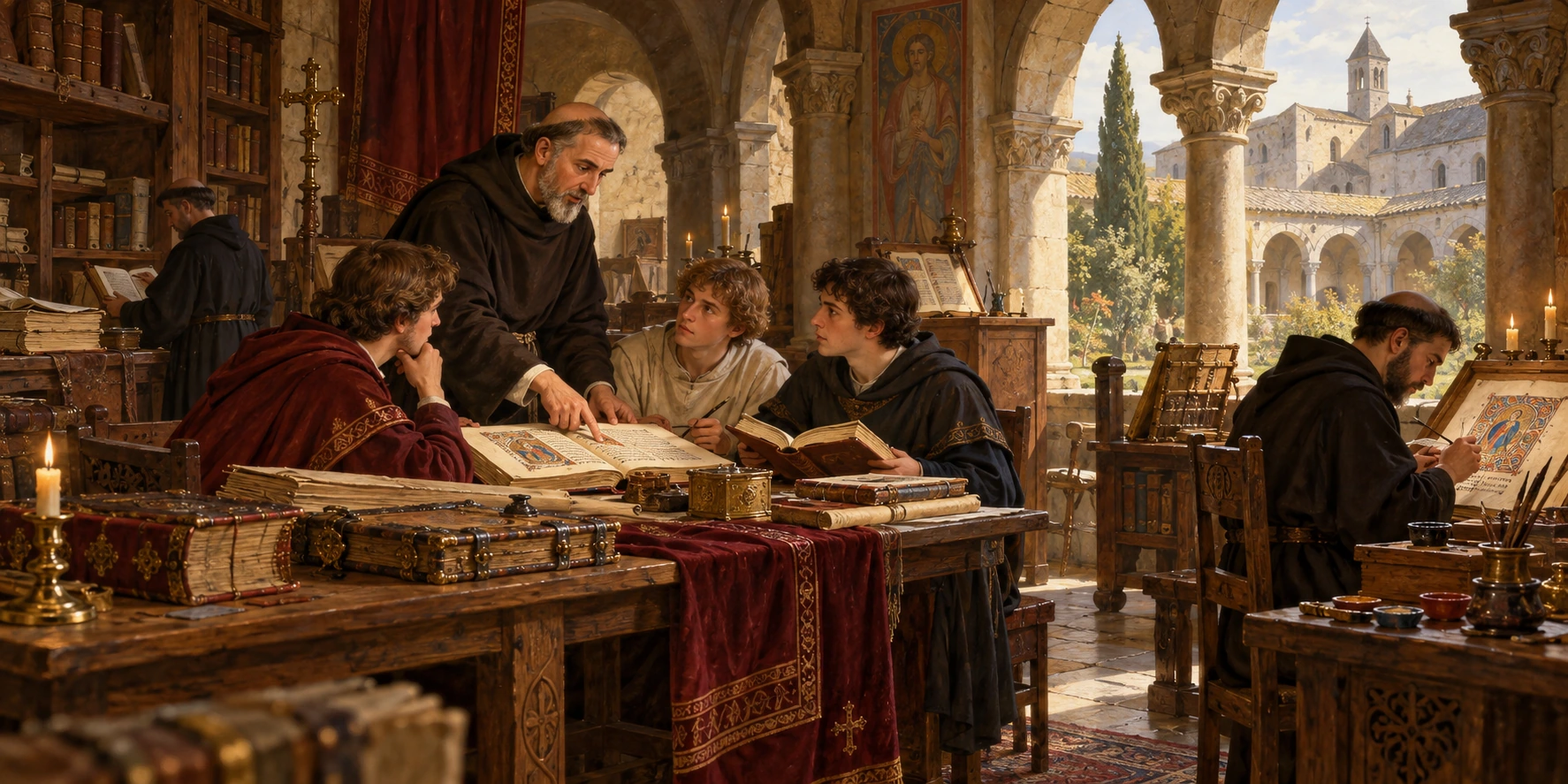
Carolingian monastic schools and manuscript culture, c. 800
Carolingian monastic schools and manuscript culture, c. 800.
3Long-form chapters3Disputed questions7Internal source connections

Historical geography · 719–843

Carolingian reform: mission, books and royal power

The Rhine connected the Frankish heartlands with mission territories to the east; the Alps connected royal power with Lombard Italy and Rome. The sequence moves from Boniface’s ecclesiastical foundations to the educational centres associated with Alcuin and Theodulf. Aachen, Tours and monastic scriptoria show how royal legislation became councils, schools, corrected books and preaching. Later divisions of the empire changed the political map without erasing all of these networks.

The story through719Move the timeline to reveal events
Earlier events stay visible as the story unfolds.
Carolingian reform: mission, books and royal powerRome · 719Boniface receives a Roman mission
Mission / preachingMonastery / religious houseWitness / martyrdomChurch / pastoral renewalAssembly / settlementSchool / scholarshipCity / civic centreCouncil / synod

13 dated records · 3 historical periods

Link to this view

Move the timeline to reveal events in date order; previous events remain visible. Select a numbered badge to separate nearby records. Fine leader lines connect displaced symbols to their locations. Drag to move the map; use +/− to zoom. Left/Right changes year and Home fits the focused map. Dashed connections are schematic, and city locations are approximate.

Chronological index · all 13 dated records
  1. 01 · 719 · RomeBoniface receives a Roman mission → chapter 1

    Pope Gregory II commissioned the Anglo-Saxon missionary later known as Boniface to preach among peoples east of the Rhine. Rome supplied an ecclesiastical relationship within which missionary preaching and episcopal organisation could develop. This was not a national church founded by a later German state. The marker establishes the institutional origin of a mission whose long-term strength depended on trained clergy, correspondence and communities capable of continuing beyond one preacher’s lifetime.

  2. 02 · 12 March 744 · FuldaSturm establishes Fulda → chapter 1

    Sturm founded the monastery of Fulda under Boniface’s direction. A stable religious house could provide prayer, formation, books and a continuing base for ecclesiastical life beyond the itinerary of a missionary bishop. Boniface later asked to be buried there. The foundation therefore joins mission to institutional memory: Christian continuity depended on communities with obligations and resources, not only on an initial baptism or the protection of a powerful patron.

  3. 03 · 5 June 754 · DokkumBoniface and companions killed → chapter 1

    Boniface and his companions were killed near Dokkum during his final mission in Frisia. The martyrdom ended his personal work but did not extinguish the dioceses, houses and relationships formed during earlier decades. The episode should not be made into an accusation against later populations. Its place in the dossier is the cost of missionary witness and the distinction between a preacher’s death and the survival of an organised Christian community.

  4. 04 · 754 · Saint-DenisStephen II anoints Pepin → chapter 1

    Pope Stephen II anointed Pepin and his sons at Saint-Denis during the developing alliance between Rome and the Carolingian dynasty. The papacy faced Lombard pressure in Italy, while Pepin sought secure Christian kingship. Their purposes converged without becoming identical. The ceremony illustrates why royal protection could matter to ecclesiastical freedom, and why dependence on a protector could also create lasting questions about appointments, property and the reach of political power.

  5. 05 · 777 · PaderbornRoyal assembly in conquered Saxony → chapter 2

    Charlemagne held a Frankish assembly at Paderborn on Saxon soil while conquest and Christianisation were proceeding together. This setting helps explain why royal demands for submission could become entangled with religious demands. The harsh Saxon capitulary, whose precise dating is debated, later prescribed death for refusal of baptism. Political obedience and sacramental initiation must therefore be distinguished: a ruler’s capacity to compel an outward act could not itself produce instructed faith.

  6. 06 · Late eighth century; exact date disputed · FuldaA letter makes learning a pastoral duty → chapter 1

    Charlemagne’s letter addressed to Abbot Baugulf urged monasteries and bishoprics to cultivate learning because defective language could obstruct understanding of Scripture. Fulda represents the named recipient, not a securely known place of composition. The document is prescriptive: it states a programme, rather than proving that every school achieved it. Its connection between moral discipline, accurate reading and instruction explains why grammar and book correction belonged inside a religious reform.

  7. 07 · 23 March 789 · AachenThe Admonitio generalis → chapter 1

    Issued at Aachen, the Admonitio generalis assembled an extensive programme of ecclesiastical and moral correction. Charlemagne addressed worship, clerical conduct and the instruction needed for reliable Christian life. Its educational provisions belong with the work of bishops, monasteries and royal agents. The document shows an ambition to govern by Christian norms; it does not demonstrate uniform compliance across the kingdom or make royal commands the source of the Church’s sacramental authority.

  8. 08 · 796–804 · ToursAlcuin directs Saint-Martin → chapter 2

    Alcuin became abbot of Saint-Martin at Tours after years in Charlemagne’s scholarly circle. Teaching and the preparation of reliable books linked the royal reform to the daily labour of a religious community. His wider insistence that conversion required instruction also challenged the identification of baptism with conquered status. Tours represents a centre of this educational network, not the single birthplace of all Carolingian script or a universal school serving every part of the empire.

  9. 09 · 25 December 800 · RomeCharlemagne crowned emperor → chapter 1

    Leo III crowned Charlemagne emperor in Rome on Christmas Day. The imperial title gave the Western settlement a new political and symbolic form, while raising questions about the empire centred on Constantinople. The ceremony did not create episcopal ordination or make Christian doctrine a royal grant. Read alongside the educational markers, it reveals two related but distinct dimensions of Carolingian history: the construction of political authority and the correction of Christian institutions.

  10. 10 · 816–817 · AachenAachen’s monastic reform assemblies → chapter 3

    Under Louis the Pious, assemblies at Aachen promoted a more regular common life for religious communities, with Benedict of Aniane playing a major role in monastic reform. The Benedictine Rule offered a shared discipline of prayer, reading, work and obedience. Legislation could clarify expectations, but did not erase local resources or customs at once. This marker connects the reform programme to institutional practice rather than treating a capitulary as proof of universal achievement.

  11. 11 · c. 819–830 · St GallThe Plan of St Gall → chapter 3

    The famous plan associated with Abbot Gozbert of St Gall was made at Reichenau and presents an ideal monastic arrangement. Its church, reading and working spaces make visible a comprehensive religious life rather than a monastery conceived simply as a library. The drawing cannot be treated as a measured plan of buildings actually completed. Its survival nevertheless preserves unusually rich evidence for Carolingian thinking about worship, hospitality, labour and community organisation.

  12. 12 · 822 · CorveyCorvey takes root on the Weser → chapter 2

    The Carolingian monastery of Corvey was established on the Weser in 822, within a region transformed by Frankish conquest. Its later religious and intellectual life belongs to the history of communities appropriating Christianity across generations. The foundation does not retrospectively justify coercive conversion during the Saxon wars. Instead, it allows a separate question: how a durable house of prayer and learning could develop after the military settlement and continue under changing rulers.

  13. 13 · August 843 · VerdunPolitical partition at Verdun → chapter 3

    Lothair, Louis the German and Charles the Bald agreed at Verdun to divide the Carolingian empire. The original treaty text is lost, so this marker identifies the attested settlement rather than reconstructing its borders. The division is a useful endpoint for testing what reform had made durable. Monastic rules, manuscripts, schools and ecclesiastical relationships did not vanish when imperial unity broke apart; their continuity must be followed through particular institutions.

Map sources and geographical method

This map follows the dossier’s selected places and institutions. Events appear at the start of their stated date range and remain visible at later steps. Their continued visibility records the earlier event, not uninterrupted control or activity. Physical geography supplies orientation; no historical state boundaries are reconstructed. Institutional and comparison lines are schematic, and representative locations are identified in the record notes.

Related library passages supply theological and institutional background; the evidence listed for each event supplies its particular historical reference. Bibliographic addresses below are documentation, while reading links stay within Catholon.

  1. Boniface: correspondence and papal commissions — Letters of Saint Boniface, trans. Ephraim Emerton; Gregory II’s commission of 719

    Primary correspondence for Roman authorisation; distinguish the edition’s commentary from the surviving letters.

  2. Benedict XVI: Saint Boniface — General audience, 11 March 2009; final mission and martyrdom

    Institutional account of Boniface’s missionary purpose, Roman relationship and death at Dokkum.

  3. Fulda Abbey: historical foundation — Catholic Encyclopedia, Fulda; foundation, 12 March 744

    Historical reference for Sturm, Boniface and the monastery; read dated interpretation critically.

  4. City of Saint-Denis: the basilica cathedral — Historical overview; Pepin’s anointing in 754

    Municipal heritage account locates the papal ceremony at Saint-Denis.

  5. Einhard: Life of Charlemagne — Chapters 6, 25–29; Turner translation, 1880

    Primary narrative for papal–Frankish relations, learning and the imperial coronation; older editorial dates require care.

  6. City of Paderborn: imperial palaces — Account of the 777 royal assembly

    Municipal archaeological and historical context for the assembly on Saxon soil.

  7. Charlemagne: Capitulary for Saxony — Capitulatio de partibus Saxoniae, especially baptism and capital penalties

    Primary legislative evidence; the edition gives the broad dating 775–790, so it is not assigned a fictitious exact day or venue.

  8. Charlemagne: Letter on the cultivation of learning — Letter to Baugulf; Munro translation

    Primary text for the relation of learning, accurate language and biblical understanding; composition date remains approximate.

  9. MGH: Die Admonitio generalis Karls des Großen — Edition notice; 23 March 789 and programme of correction

    Specialist institutional verification of the capitulary’s date and character.

  10. FranceArchives: Alcuin — National historical commemoration; court and Tours

    French national archives account for Alcuin’s educational role and move to Tours.

  11. Geschichtsquellen: Alcuinus abbas S. Martini Turonensis — Biographical record and catalogue of works

    Scholarly institutional catalogue records York, court service, Tours in 796 and death in 804.

  12. MGH: Die monastische Gesetzgebung von 816 und 817 — Study of Aachen’s monastic capitularies

    Specialist analysis of the legislation and Benedict of Aniane’s involvement; not evidence of uniform implementation.

  13. e-codices: Codex Sangallensis 1092 — Catalogue record for the Plan of St Gall

    Manuscript catalogue dates the plan approximately to 819 or c. 827–830 and places its production at Reichenau.

  14. UNESCO: Carolingian Westwork and Civitas Corvey — Description and outstanding universal value

    Institutional heritage record for Corvey’s Carolingian setting and surviving remains.

  15. Corvey: historical and architectural account — Foundation stone, 822; church consecration, 844

    Site institution supplies the local building chronology.

  16. Bibliothèque nationale de France: Traité de Verdun, 843 — Authority record; August 843 and loss of original text

    National-library record supports the named parties, date and documentary limitation.

Physical geography: Natural Earth, 1:10m public-domain land, coastlines, natural lakes and major rivers. Projection: Web Mercator; high latitudes are enlarged. Contemporary coastlines provide orientation rather than a reconstruction of every historical shoreline. The map’s city coordinates locate named places approximately, not exact buildings.

Extended reading

History and institutions

Chapter 01

St. Boniface, the schools and a renewed Christian society

A missionary bishop in the eighth century faced more than a question of persuading an isolated hearer. Baptism had to be followed by a stable community, an instructed clergy, books, places of worship and a means of maintaining discipline across considerable distances. Boniface’s work in the German lands therefore combined preaching with the foundation and correction of ecclesiastical institutions. His Roman commissions and correspondence belong to the history of communion and canonical organisation, not merely to a retrospectively constructed German national story. His death at Dokkum in 754 ended a particular mission; it did not dissolve the dioceses, monasteries and relationships that had given the work continuity.

The alliance between the Carolingians and the papacy gave this institutional programme exceptional political resources. Pepin’s kingship and the papal connection of the 750s cannot be reduced either to a purely spiritual event or to a cynical exchange of religious legitimacy for military protection. The papacy faced the concrete pressure of Lombard power in Italy; the Frankish monarchy sought a stable Christian kingship and a settlement of its own succession. These purposes were not identical, but they could converge. The resulting territorial arrangements also created long-term problems: a pope defending the freedom of his office could become entangled in alliances, fortifications and fiscal administration. Recognising those problems explains why ecclesiastical independence mattered; it does not make independence from every secular protector a readily available eighth-century option.

The reform of learning addressed a practical shortage. A priest needed sufficient Latin to understand the books from which he taught and celebrated; a community needed copies that did not reproduce errors indefinitely. Alcuin’s work at Charlemagne’s court and later at Tours belonged to this effort. Grammar, reading and correction were therefore pastoral tasks as well as literary ones. An improved biblical text could serve many houses through the production of further copies.

Fulda, founded in 744 under St. Sturm with St. Boniface’s support, illustrates the multiplication of institutions behind the famous names. A monastery trained members, sustained worship and became a centre of books and instruction. Episcopal organisation and monastic foundations reinforced each other without being identical. The result was a network capable of forming clergy and maintaining Christian life across territories whose political allegiance might change. That durable provision is the constructive centre of the Carolingian achievement.

01“The Church was only the king’s administrative instrument.”

The historical evidence

Boniface sought Roman advice and trained clergy; monasteries preserved books and religious observance; Alcuin criticised coercive conversion. Those activities had purposes and standards which a royal command did not create. Frankish resources supported them, but did not supply the content of the faith or the reason for monastic life.

Answer to the objection

Royal patronage could subordinate particular appointments to politics. It does not explain away every school or mission. The criticism of royal methods by churchmen is direct evidence that cooperation and obedience to God were not identical obligations.

Chapter 02

Saxony: conquest, baptism and the demand for instruction

The Saxon wars, conventionally dated from 772 to 804, expose a serious tension within Carolingian Christian kingship. Frankish expansion confronted political resistance, warfare and religious difference in the same territory. Royal legislation could consequently treat rejection of baptism as resistance to public order. The harsh Capitulatio de partibus Saxoniae prescribed severe penalties for a range of offences, including refusal of baptism. The later Capitulare Saxonicum of 797 reflected a less uniformly punitive arrangement. Neither document should be projected onto every missionary encounter, but neither should be omitted from an account of the conquest. The distinction between the king’s coercive policy and the nature of Christian faith must be made from the evidence, not manufactured to protect a preferred conclusion.

Alcuin’s criticism is especially valuable because it arose within the Carolingian Christian world. He urged instruction and persuasion and opposed the assumption that an external act could substitute for believing assent. His concerns about burdens placed on newly converted populations likewise show that evangelisation could be damaged by fiscal and administrative demands. These were not objections from a modern secular theory of religion. They arose from the nature of baptism, the need for teaching and the proper ordering of a Christian ruler’s responsibilities. Later scholastic discussion, especially Aquinas’s treatment of unbelief, makes the theological distinction explicit: those who have never received the faith are not simply to be compelled to believe. That later text illuminates the principle; it should not be pretended to be an eighth-century statute.

The criticism associated with Alcuin was directed at the means of conversion. Compulsion could obtain submission or a baptismal act without giving people the instruction required to understand the faith. Heavy burdens imposed upon a recently conquered population could make Christian teaching appear to be another instrument of domination. The answer was catechesis, patient preaching and the formation of clergy able to teach. The objection came from within the programme of Christian renewal, not from indifference to evangelisation.

The Capitulatio de partibus Saxoniae belongs to the harsh phase of royal legislation; the later Capitulare Saxonicum of 797 reflects a changed legal settlement. These stages show a policy developing through war and resistance. Christianity’s lasting presence in Saxony depended on churches, dioceses and religious communities after campaigns had ended. The missionary objective was a people able to worship and live the faith. Royal force could change the ruler of a territory; it could not supply that interior and institutional work by itself.

02“Conversion was simply another name for conquest.”

The historical evidence

The Saxon wars involved severe coercion, and royal legislation linked political obedience to baptism. Alcuin’s insistence upon instruction identified the defect: submission cannot by itself teach the faith. The later provision of churches, ministers and catechesis did work that a victorious army could not perform.

Answer to the objection

Conquest explains part of the political setting. It does not account for the content of preaching, the formation of clergy or the transmission of Christian life after war ended. Those institutions made the religious inheritance durable; unjust punishments do not become necessary expressions of their purpose.

Chapter 03

Legible books and the survival of ancient learning

Carolingian political unity did not survive intact. The settlement at Verdun in 843 divided the empire among the sons of Louis the Pious, and later generations faced further divisions and external attacks. It is therefore misleading to describe the reform programme as a finished blueprint imposed permanently on the whole of Europe. Its durability lay partly in institutions that could operate under changing rulers. A monastery possessed a rule of life, a liturgical calendar, a body of books and relationships with patrons and other houses. A cathedral school trained clergy who might serve beyond the immediate locality. These arrangements transmitted habits even when political borders changed.

The reforms associated with Benedict of Aniane and the Aachen legislation of 816–817 sought a more consistent monastic observance. They did not erase the differences among all religious communities overnight, and the resources available to great royal abbeys were not those of every smaller house. Nevertheless, the attempt to order common life around a recognisable rule mattered. The Benedictine pattern joined prayer, reading, work, obedience and hospitality. Manuscript production developed inside that larger religious purpose. To praise monks only because they preserved classical literature is to miss the reason they cared for books at all: sacred reading and the celebration of the divine office were central obligations, and the auxiliary arts helped them fulfil those obligations intelligently.

Caroline minuscule supplied a clear and increasingly regular book hand. Its significance was cumulative: a manuscript that one house could read accurately could become the exemplar for another. Word separation, correction and trained copying made the page easier to use. Books remained expensive, but the investment in producing reliable copies reduced the loss introduced by repeated errors. The reform joined the school to the workshop of the scribe.

The surviving manuscripts are the result. Biblical texts, patristic works and Latin authors passed through Carolingian copying campaigns and later libraries. Their preservation did not depend on a modern division between useful secular literature and useless religious work. Grammar assisted biblical interpretation; ancient prose trained readers in Latin; history supplied models and warnings. The Christian school had reasons to preserve a broad inheritance. The books available to later medieval scholars and humanists were enlarged by that work, even where those readers criticised earlier interpretations.

03“A religious school could only repeat inherited ignorance.”

The historical evidence

The correction of books demanded comparison, grammar and judgment. Alcuin’s work at Tours and the spread of more legible manuscripts supplied later readers with better texts. Copyists had to identify and avoid errors, and students learned skills needed for Scripture, liturgy and government.

Answer to the objection

Preservation and correction are intellectual achievements. They made further argument possible by maintaining reliable material upon which to work. The survival of classical and Christian texts through these institutions contradicts the assertion that their religious character made learning impossible.

Further reading

People, institutions and turning points

8th centuryMission became lasting when churches could train successors

The conversion of a ruler or the arrival of a missionary could open a territory, but neither ensured a lasting Christian community. Boniface’s work joined preaching to the establishment of sees, the correction of clerical conduct and communication with Rome. The resulting network supplied people and institutions that a single journey could not.

  • Boniface and Rome. Consecration and papal correspondence gave Boniface an ecclesiastical commission. His appeals concerned bishops, clergy and discipline as well as the conversion of pagans; mission and the reform of existing Christians belonged together.
  • Pippin’s kingship. Pippin’s anointing and alliance with the papacy connected Frankish power with the protection of Rome. That alliance created resources and obligations; it also made the Church vulnerable to the ambitions of a powerful protector.
  • The Saxon wars. Charlemagne’s campaigns combined territorial conquest and religious demands. Punitive legislation and compelled conformity must be distinguished from the persuasion and formation that Christian faith requires. Alcuin’s letters explicitly treated instruction and willing belief as essential.
  • Italy enlarged the task. The conquest of the Lombard kingdom in 774 brought additional churches, laws and traditions under Carolingian power. Reform now had to work across a large and varied political territory rather than through one uniform local society.

The enduring achievement was a network of dioceses, monasteries and trained clergy. Royal force could impose obedience, but instruction, worship and successors were required to give a community a Christian life beyond the military campaign.

late 8th–early 9th centuriesCorrect books, intelligible preaching and local teaching

Carolingian correctio addressed mistakes that affected worship and instruction. A poorly copied text could distort what a priest read; an untrained reader could misunderstand it; a sermon in an inaccessible language could leave the congregation uninstructed. The programme therefore joined books, teachers and pastoral responsibility.

  • Alcuin’s programme. Alcuin’s teaching and correspondence encouraged grammar and careful reading in the service of Scripture. The royal letter on learning links correct expression with sound understanding; literacy appears as a means to faithful instruction.
  • The Admonitio generalis. The legislation of 789 called for correction in religious life and learning. Its concern with schools and books connected royal authority with work that had to be carried out by bishops, abbots and local teachers.
  • Theodulf’s local emphasis. Theodulf’s episcopal instructions concerned the competence of clergy and access to teaching. Reform mattered at parish level: a polished court circle was insufficient if ordinary clergy could not explain the faith.
  • Tours in 813. The Council of Tours required homilies to be rendered into the vernacular Romance or Germanic speech so that people could understand. Latin learning and intelligible preaching were complementary obligations, not rival programmes.

Scriptoria, corrected biblical texts and clearer handwriting made the educational programme materially possible. The evidence supports a deliberate renewal of Christian learning; it does not require the claim that every inhabitant of the empire became literate.

800–843Reform involved households, estates and contested authority

The imperial coronation of 800 gave Charlemagne’s rule a new dignity, but the work of government still depended on people collecting resources, hearing complaints and managing distant communities. Ecclesiastical reform entered this practical world of land, obligations and divided loyalties.

  • Agents of government. The missi dominici were sent to supervise local government and hear grievances. Their existence reveals both the ambition to correct abuse and the difficulty of governing through powerful local officeholders.
  • Monks and canons. The Aachen reforms under Louis the Pious sought a clearer organisation of different religious lives. Benedictine observance for monks and regulations for canons recognised that common worship could belong to distinct institutions.
  • A laywoman’s instruction. Dhuoda’s Manual for her son William, written in the 840s, joins Scripture, prayer, moral counsel and obligations to father and ruler. It makes a learned Christian household visible within a history often told only through kings and abbots.
  • A divided inheritance. Civil conflict under Louis and the settlement of Verdun in 843 divided political power. Books, trained clergy and religious customs nevertheless continued across the new boundaries; cultural transmission was not confined to one imperial administration.

The Carolingian achievement was sustained by estates and labour as well as scholars. Its weaknesses were also institutional: divided succession and local power could frustrate correction. The surviving books and schools show which parts endured after the political unity broke.

9th–10th centuriesWhat survived the empire’s divisions

A political collapse need not erase every form of organised work. Carolingian learning continued through monasteries, episcopal centres and households that retained books and trained successors. Later reforms inherited these resources while changing the legal arrangements that protected them.

  • Hincmar’s episcopal work. Hincmar of Reims combined pastoral supervision with political and canonical argument. His career shows the bishop as an administrator and counsellor whose responsibilities crossed the modern division between church and public life.
  • Eriugena and Greek learning. John Scottus Eriugena’s work at the Frankish court drew on Greek Christian writings and Latin philosophical argument. His achievement depended on texts, patronage and an audience able to engage with difficult theological language.
  • Raids and relocation. Attacks could scatter communities and their possessions. Monks moved relics and books, found protection and re-established observance. Survival often involved mobility and rebuilding rather than uninterrupted peace behind an abbey’s walls.
  • New protections. Cluny’s foundation in 910 proposed a distinctive protection for monastic life. Ottonian rulers subsequently relied heavily on bishops and abbots. These arrangements inherited Carolingian personnel and learning while creating new relationships between patrons and religious institutions.

The strongest measure of continuity is transmission: texts copied again, practices taught again and communities restored after disruption. The renewal mattered because it created habits and institutions that could function beyond the reign that had encouraged them.

Documents and records

Read the sources

Collections and edition notes
Carolus Magnus, Admonitio generalis (789), educational provision

Source excerpt

Et ut scolae legentium puerorum fiant.

An excerpt is reproduced here; this is not the complete document.

The provision calls for schools in which boys learn to read. Its prescription must be distinguished from evidence of actual attendance.

Einhardus, Vita Karoli Magni, 25–27

Document guide · no excerpt supplied

This entry provides context for the document; it does not reproduce its text.

A contemporary biography describes the king’s learning and religious life. Read it as a court-connected witness, not a neutral survey of the whole population.

Continue studying

Terms, related dossiers and source readers

Carolingian correctio

Correctio was the programme of religious, educational and moral correction pursued under the Carolingian rulers, especially through legislation, episcopal oversight, schools and the improvement of books and worship.

Monastic exemption and institutional freedom

Monastic exemption is a legal arrangement that removes a religious house, in specified matters, from ordinary local ecclesiastical control and places it under another authority, often direct papal protection.